

A Practical Guide: How to Choose the Right PLC for Your Industrial Scalability

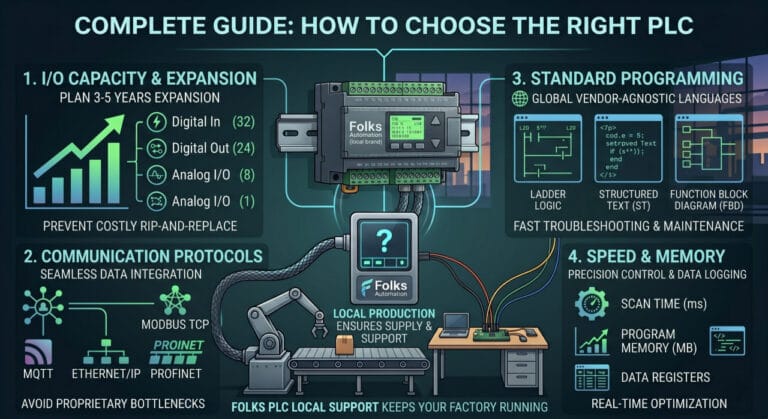
Choosing the wrong Programmable Logic Controller (PLC) can lead to production downtime, inflated integration costs, and significant obstacles for future expansion. In the modern industrial automation ecosystem, a PLC is no longer just a mechanical relay replacement; it is the core “brain” connecting field sensors to higher-level analytics systems like SCADA. If you are new to this technology, you can learn more about the fundamental role of a PLC in industrial automation systems to better understand how these controllers drive modern production lines.
This article dissects the technical parameters for choosing the right PLC based on operational requirements and how you can avoid common specification errors during the procurement phase.
4 Key Technical Parameters for Choosing a PLC
Many technicians fall into the trap of brand loyalty. In reality, technical specifications and system compatibility are far more crucial. Analyze the following four parameters before making your decision.
1. I/O (Input/Output) Capacity and Scalability
The most common fatal mistake engineers make when selecting a PLC is counting only the sensors and actuators needed for today. You must project your operational system architecture for the next three to five years. If you lock your specifications into just-enough I/O capacity now, you will hit a technical wall when the factory demands production line expansion or the addition of inspection stations.
To prevent this, evaluate the specific signal types your system requires, along with safety margins. For discrete operations—such as reading limit switches, mechanical buttons, or on/off actuators—you must prepare sufficient digital signal ports. Conversely, if your production process controls continuous variables—such as regulating boiler temperature, compressor pressure, or fluid flow using PID control algorithms—you absolutely require analog signals. Pay close attention to the analog resolution level in the PLC specifications, as low resolution will result in inaccurate sensor readings and immediately compromise your product quality consistency.
To guarantee scalability, design your system using a flexible hardware architecture. Choose a PLC that inherently allows you to install additional I/O expansion modules at any time. This flexibility frees you from the need to replace the main CPU (Central Processing Unit) when the number of control points increases in the future. You not only save on re-procurement budgets but also minimize the costly risk of system downtime during upgrades.
2. Communication Protocol Compatibility
Modern industrial control systems demand seamless data integration to build a solid Industrial IoT architecture. A PLC that is isolated and incapable of comprehensive communication will only become a “blind spot,” limiting your factory’s oversight and operational efficiency. To prevent data exchange bottlenecks between machines, you must ensure the PLC supports industry-standard open protocols, such as Modbus RTU/TCP, Ethernet/IP, or Profinet. This standardization guarantees smooth communication across devices without binding you to a single vendor’s closed ecosystem.
Beyond software capabilities, hardware specifications also play a crucial role in integration smoothness and budget efficiency. If you are planning advanced integration with SCADA systems or HMI (Human Machine Interface) units, ensure that physical communication ports like RS-485 and Ethernet are available natively on the CPU unit. The availability of these built-in ports not only simplifies network topology but also prevents budget inflation caused by the need to purchase additional communication expansion modules, which are expensive and consume space in the control panel.
3. Support for Programming Language Standards (IEC 61131-3)
The transition of new engineers or operators will be hindered if the PLC uses proprietary programming languages. Choose a PLC that supports the international IEC 61131-3 standard. This standard ensures that the PLC can be programmed using Ladder Diagram (LD), Structured Text (ST), or Function Block Diagram (FBD). The use of a global standard accelerates troubleshooting and reduces dependency on one specific technician.
4. Execution Speed (Scan Time) and Memory Capacity
Industrial processes with high-precision mechanical movements (such as packaging machines or CNCs) require scan times measured in milliseconds.
- Check the execution speed per instruction on the datasheet.
- Ensure that the program memory capacity is sufficient to accommodate complex logic, and that the data memory (data registers) is adequate to store operational logs before they are retrieved by monitoring systems.
Here is the translation for the case study and the implementation challenges in Indonesia, keeping the professional and technical tone appropriate for engineering stakeholders:
Case Study: Scalability Failure on a Packaging Line
Let’s look at a real-world example of a mid-sized bottling plant in Europe that experienced production bottlenecks. Initially, plant management chose a low-cost PLC with fixed I/O and relied solely on basic serial communication. Two years later, the factory planned to automate a visual inspection system and integrate the packaging line into the central ERP system for real-time monitoring.
Problems Encountered:
- The old PLC’s memory capacity could not process the additional logic instructions.
- There were no native Ethernet ports to send data to the server.
- The system architecture rejected additional I/O expansion modules.
Solution and Impact: The factory was forced to perform a “rip-and-replace” (completely removing the old system and replacing it with a new one). They lost two weeks of production time and wasted the initial hardware investment. If they had calculated I/O scalability and network communication from the beginning, this upgrade cost could have been reduced by up to 70%.
Challenges of PLC Implementation in Indonesia
In Indonesia, the challenges of selecting a PLC often shift from technical issues to logistics and after-sales support. Local industries frequently face:
- Long Lead Times: Dependence on imported PLCs results in procurement lead times ranging from weeks to months.
- Lack of Local Technical Support: When bugs or protocol integration difficulties occur, assistance from overseas principals is often slow and incurs high consultation fees.
- Over-specification: Purchasing the highest, most expensive series of a global brand, even though the logic requirements could be met with mid-range specifications.
Aligning System Specifications with Local Solutions: The Role of Folks Automation
Reading technical data sheets is often insufficient to guarantee successful integration if you lack a discussion partner who understands real-world conditions on the factory floor. Choosing a PLC is not merely a hardware procurement transaction; it is a strategic long-term investment. This is where Folks Automation steps in to fill the gap in the nation’s automation ecosystem.
As Indonesia’s first local PLC manufacturer, Folks Automation designs hardware and software specifically engineered to address the challenges of local industries. We eliminate classic issues such as long procurement lead times caused by dependence on imported goods. Folks Automation PLCs are produced to ensure rapid unit availability, are integrated with modern industrial communication standards, and are designed to be robust enough for heavy factory operational loads.
More than just a hardware provider, the Folks Automation engineering team positions itself as your technical partner. We do not leave you to design your system in isolation. We analyze your design assumptions, test the operational engineering logic, and offer alternative architectural perspectives that may be more efficient.
If you are unsure whether your production line requires complex PID control, are confused about mapping SCADA topology, or simply want to ensure that your chosen programming language does not lock you into a single vendor (vendor lock-in) in the future, we are ready to assist. Do not let your factory grind to a halt due to an incorrect control system choice. Contact Folks Automation via WhatsApp at +6282114044968 to consult and build the most efficient, scalable, and fit-for-purpose PLC architecture.