

The Complete Guide to Choosing the Right Industrial Controller


Selecting a Programmable Logic Controller (PLC) is not just about purchasing hardware; it is an investment in the heart of your production efficiency. As solution providers who have managed hundreds of system integrations across various sectors—from food manufacturing to wastewater treatment—we understand that choosing the wrong PLC capacity leads to two costly outcomes: budget bloat from being over-spec or system failure during future expansions from being under-spec.
This article provides a comprehensive breakdown of PLC types based on capacity to help you, as engineers, make precise technical decisions.
How to Evaluate PLC Capacity: Key Technical Parameters Explained
Before diving into implementation details, your understanding of PLC capacity must be grounded in three primary technical parameters that dictate control system performance in the field: I/O capacity, memory capacity, and processing speed (scan time).
I/O (Input/Output) Capacity
I/O represents the physical and logical boundaries regarding how many signals a single PLC unit can manage simultaneously. This refers to the number of addresses the processor can map to read inputs (such as sensors, limit switches, or push-buttons) and drive outputs (such as solenoids, contactors, or Variable Frequency Drives).
In terms of significance, PLC I/O is divided into two categories:
- Fixed I/O: PLCs with a factory-defined number of I/O points that cannot be modified, typically intended for simple, stand-alone machinery.
- Modular I/O: PLCs that allow for capacity expansion by installing additional modules onto a rack or backplane.
For implementation, precise I/O capacity planning must include a 15–20% spare capacity. Without this buffer, adding new features or sensors in the future will force a complete overhaul of your system architecture.
Memory Capacity
Memory acts as the manager’s “brain,” allowing the PLC to store and execute complex SOPs (program instructions) effectively.
Processing Speed (Scan Time)
Processing speed determines how quickly the PLC manager can make decisions when issues arise in the field.
Choosing a PLC that is undersized is like appointing a single manager to lead 1,000 staff members; the system will inevitably become overwhelmed and fail. Selecting the right controller ensures your production line remains efficient, responsive, and ready for future growth.
1. Micro PLC (Small-Scale Capacity)
A Micro PLC is the ideal solution for stand-alone applications that do not require massive data integration.
Technical Characteristics:
- I/O Count: Typically supports up to 32 or 64 I/O points.
- Design: Generally features a “brick” (compact) design where the CPU, power supply, and I/O are integrated into a single unit.
- Memory: Limited capacity, sufficient only for basic logic instructions (simple Ladder Diagrams).
Read More: The Role of PLCs in Industrial Automation Systems
Ideal Applications: These controllers are perfect for small-scale machinery, such as automated packaging systems, simple pump controls, or short conveyor lines.
2. Small PLC (Lower-Mid Capacity)
This is the type we most frequently encounter in the field due to its ideal balance between cost and functionality.
Technical Characteristics:
- I/O Count: Capable of handling between 64 and 256 I/O points.
- Expansion: Begins to support additional expansion modules, allowing you to easily add more sensors as your needs grow.
- Communication: Equipped with communication ports (such as Ethernet or RS-485) for seamless integration with an HMI (Human-Machine Interface).
Ideal Applications: Perfect for small production line automation, elevator control systems, and building HVAC systems.
3. Medium PLC (Upper-Mid Capacity)
For companies starting to implement data logging and machine-to-machine integration, a Medium PLC is the minimum standard we recommend.
Technical Characteristics:
- I/O Count: Supports up to 2,048 I/O points.
- Structure: Typically modular (using backplanes or racks), allowing you to mix various types of modules, such as Analog, Digital, and High-speed counters.
- Processor: Features significantly higher execution speeds to handle complex mathematical calculations or PID control loops.
Ideal Applications: Chemical processing plants, energy management systems, and CNC machine controls.
4. Large PLC (High-End Capacity)
This is the “monster” of the automation world. Large PLCs are designed to control entire factory areas or highly critical processes.
Technical Characteristics:
- I/O Count: Supports over 2,048 up to tens of thousands of I/O points (via Remote I/O).
- Redundancy: Supports dual CPU systems. If one CPU fails, the backup takes over instantly without halting production (Hot Standby).
- Massive Memory: Capable of storing thousands of lines of code and intricate production recipes.
Ideal Applications: Oil and gas industries, power plants, and large-scale automotive manufacturing plants.
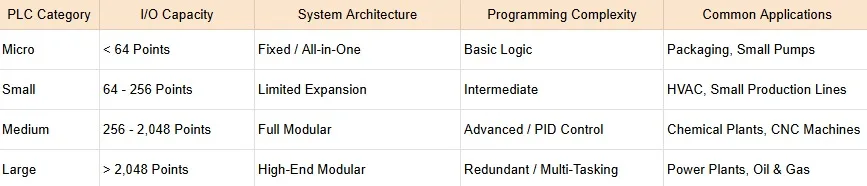
Quick Comparison Table
Case Study: Factory Efficiency Transformation in a Beverage Plant
A client of ours was initially using a Small PLC to control a single-bottle filling machine. Issues arose when they added Capping and Labeling units, which they wanted to integrate into a single automated production report.
- The Problem: The existing Small PLC was maxed out (I/O capacity exhausted), and the memory was insufficient to hold data communication instructions for the central server (IIoT).
- Our Solution: We upgraded the system to a Medium PLC with a modular architecture.
- The Benefit: I/O capacity now retains a 30% buffer for next year’s expansion.
- The Results: Machine synchronization is now more precise, reducing the cap-installation error rate by 15%, and production data can be monitored in real-time from the headquarters.
Why Capacity Isn’t the Only Deciding Factor
Based on our decades of experience, selecting a controller based solely on I/O count is a beginner’s mistake. You must also consider:
- Scan Time: How fast the PLC reads inputs and executes outputs. For high-speed machinery, you need a powerful processor even if the I/O count is low.
- Environment: Will the PLC be placed in areas with extreme temperatures or high vibration? Large capacity is useless if physical durability is low.
- Spare Parts Availability: Ensure the PLC brand and model have strong technical support in your region.
Conclusion
Understanding PLC types by capacity is the first step toward creating a robust automation system. Start by calculating your current number of sensors and actuators, then add a 20% margin for future requirements.
As your automation partner, we recommend always consulting on system architecture before making a purchase. The right PLC will become an asset, while the wrong one will only become a technical burden in the future.
Need to Optimize Your Factory’s PLC System?
Contact our expert team via WhatsApp at +6282114044968 today for a free system audit and discover the most efficient PLC capacity solution for your operational needs!