

5 Real-World PLC Applications: From Palm Oil to Packaging

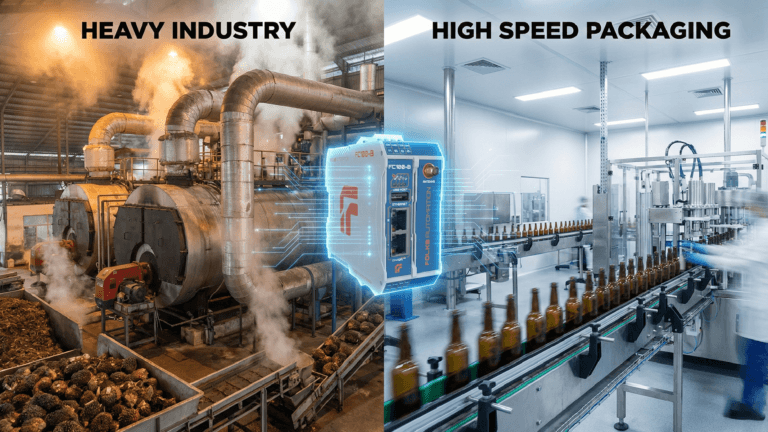
FOLKSAUTOMATION.COM – We often talk about what a PLC is, but the more important question is: what does it actually do?
For business owners and engineers, seeing is believing. Understanding real-world PLC applications in industry helps visualize how automation can solve specific production problems.
Based on the diverse industrial landscape in Indonesia, we have compiled the most common examples of how Programmable Logic Controllers (like the [Folks FC100-B]) are used in factories today.
1. Food & Beverage: High-Speed Packaging Lines
In the Food and Beverage (F&B) industry, speed and hygiene are everything.
- The Application: Bottling and Packaging.
- How it Works: Sensors detect empty bottles moving on a conveyor. The PLC triggers a nozzle to fill them with liquid, then triggers a capper to seal them—all within milliseconds.
- Why PLC: A human cannot fill 500 bottles per minute consistently. A PLC can do it 24/7 without spilling a drop.
2. Palm Oil Industry (Industri Sawit): Boiler Control
Indonesia is a global leader in Palm Oil. Automation here is critical for efficiency and safety.
- The Application: Sterilizer and Boiler Automation.
- How it Works: The PLC monitors the immense pressure and temperature inside the boilers used to cook fresh fruit bunches (TBS). It automatically adjusts valves to maintain safety levels.
- Why PLC: Using our [Remote IO FCIO Modules] allows the control room to be far away from the dangerous high-heat areas.
3. Manufacturing: Smart Conveyor Systems
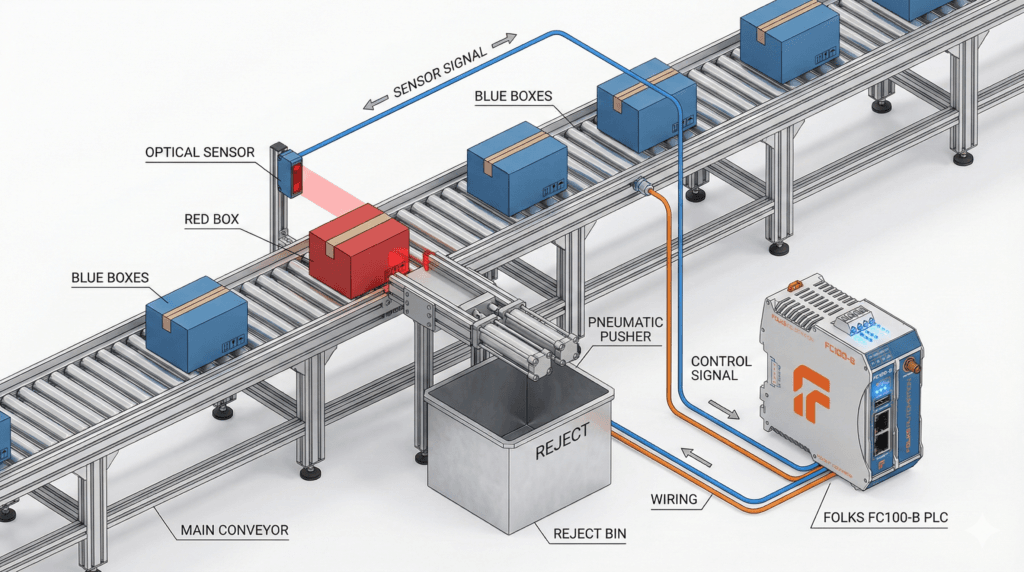
Conveyors are the arteries of any factory.
- The Application: Sorting products based on size or color.
- How it Works: An optical sensor “sees” a box passing by. If the box is the wrong size, the PLC activates a pneumatic pusher to reject it off the line.
- Why PLC: It ensures zero defects reach the customer.
4. Marine Industry (Industri Perkapalan): Alarm Monitoring
Automation isn’t just for land. Ships use PLCs for critical monitoring systems.
- The Application: Engine Room Monitoring & Alarm System (AMS).
- How it Works: The PLC continuously scans oil pressure, fuel levels, and engine temperature. If any parameter goes out of range, it triggers an alarm on the bridge.
- Why PLC: Reliability. In the middle of the ocean, you need a system that never crashes.
5. Chemical Industry: Precise Mixing
Mixing chemicals requires exact formulas. A slight error can ruin a whole batch or cause an explosion.
- The Application: Batch Processing.
- How it Works: The PLC opens valve A and valve B for a precise amount of seconds to mix chemicals in a tank, then activates a mixer motor.
- Why PLC: It guarantees the “recipe” is followed perfectly every single time.
Why Factories Choose PLCs Over PCs?
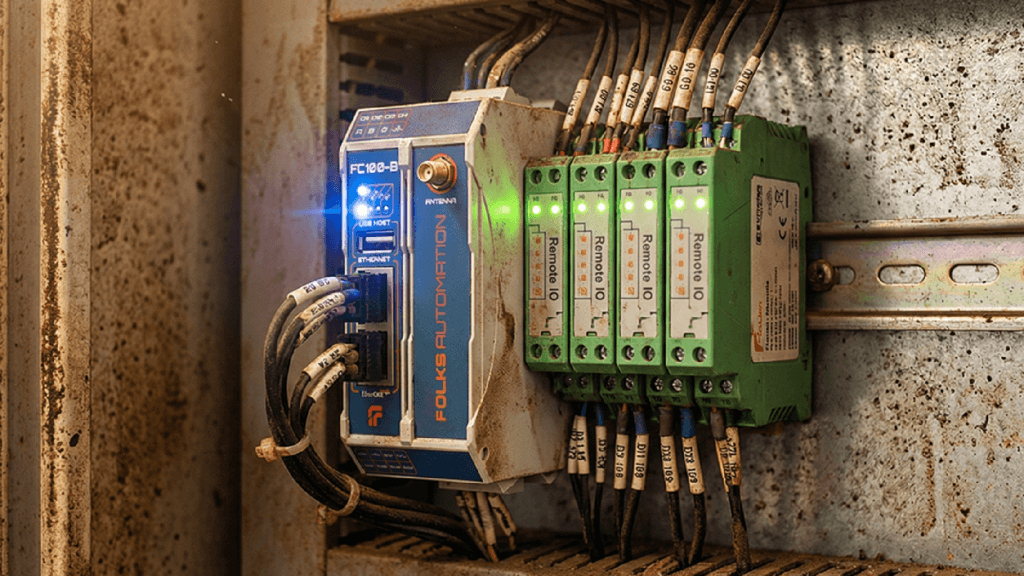
You might ask, why not just use a laptop? As highlighted in industry studies, factories choose PLCs because they are the “Core of the Automation System”. Unlike standard PCs, PLCs are:
- Rugged: Resistant to dust, vibration, and electrical noise.
- Real-Time: They prioritize scanning inputs over everything else.
- Modular: You can easily add more I/O modules as your factory grows.
Conclusion
From the heavy machinery of a palm oil mill to the delicate packaging of a beverage plant, PLCs are the silent workforce behind modern civilization.
At Folks Automation, we build controllers that handle these diverse environments. Whether you are upgrading a ship or building a new packaging line, the [Folks FC100-B] is ready for the task.
Ready to automate your specific industry? [Contact Us] to discuss your project needs.