

7 Industrial Automation Trends in 2026: From IoT PLCs to Digital Approvals

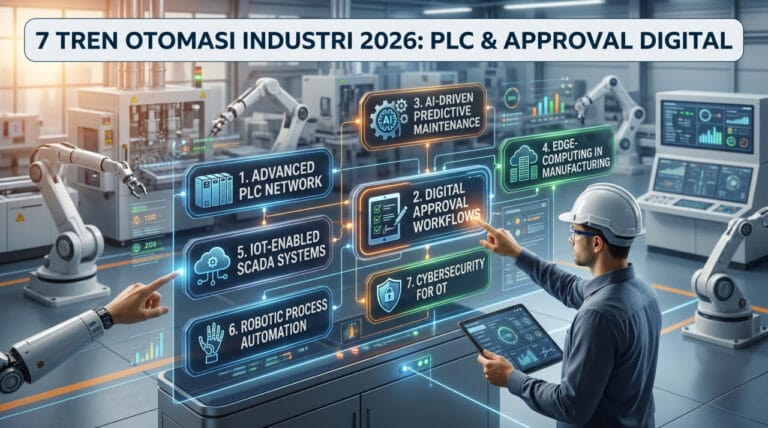
Industrial automation in 2026 demands absolute integration between mechanical hardware and business administration systems. It’s no longer just about isolated robots; efficiency is now measured by how much manual lag is eliminated from the entire workflow.
From IoT-based Programmable Logic Controllers (PLC) to paperless document authorization platforms, these innovations are reshaping the manufacturing landscape. Here are the seven key trends defining the future of factory operations.
1. The Convergence of PLC and Industrial IoT (IIoT)
By 2026, the role of the PLC shifts from a local machine controller to a critical data gateway for the cloud. This integration transforms the production floor into a fully connected ecosystem, solving the classic “data silo” problem where managers struggle to monitor real-time performance.
Modern smart factory architectures now require hardware with open protocol communication capabilities, such as MQTT, to ensure high-level data transmission. Companies like Folks Automation are leading this charge with IoT-based PLC chips that connect physical sensors directly to analytical dashboards, providing instant visibility over daily production schedules.
2. Edge Computing on the Factory Floor
Edge computing processes data directly at the source to slash server latency. This provides the absolute response speed required for autonomous machinery.
Instead of sending massive amounts of machine data to external servers—which often triggers network bottlenecks—critical engineering standards now require algorithms to run locally near the heavy equipment. Smart PLCs can now perform basic analytical computation, allowing machines to react to danger instantly without needing an active internet connection.
3. Data-Driven Predictive Maintenance
Artificial Intelligence (AI) now analyzes machine log data to predict component failure before physical incidents occur. This shifts the maintenance strategy from reactive to proactive.
In the past, sudden breakdowns could halt an entire production line, burning through operational budgets. Modern industrial automation standards utilize smart sensors to detect vibration anomalies or temperature fluctuations, triggering automatic alerts for technicians to prevent large-scale emergency repairs.
4. Collaborative Robotics (Cobots)
Collaborative robots, or “cobots,” work alongside human operators in shared spaces without safety fences. These machines take over monotonous, physically taxing tasks.
While conventional industrial robots required massive space and posed safety risks, 2026 regulations require robots to stop instantly upon physical touch. This allows assembly lines to blend mechanical precision with human cognitive flexibility, significantly saving floor space.
5. Integrating Manufacturing Execution Systems (MES) and ERP
Merging MES with Enterprise Resource Planning (ERP) allows production data to flow directly into accounting systems. This ensures that inventory reports and financial data are always in sync with actual factory output.
In a modern setup, the PLC autonomously signals the completion of a product cycle. The ERP software receives this signal and updates warehouse stock levels in real-time, allowing for a high-precision supply chain.
6. Sustainable Manufacturing through Smart Factories
Optimization of hardware and sensors is now the global standard for reducing energy consumption and material waste. Smart PLCs can dynamically adjust pump valves and conveyor motors based on actual workload.
When sensors detect no flow of goods, machines automatically enter low-power mode. This isn’t just about environmental preservation; it’s about massive energy cost efficiency that meets international environmental standards.
7. Bureaucracy Automation and Paperless Workflows
Digital administration allows operational documents to be legally authorized without stacks of paper. Often, the speed of machinery is hindered by slow, manual printing bureaucracy. Integrating a document approval system is now a mandatory trend to streamline maintenance instructions directly from a smartphone. Furthermore, for new hardware installations, vendors and technicians can finalize Handover Notes (BAST) using a digital signature application. This ensures internal bureaucracy never slows down growth.
Conclusion
Operational transformation in 2026 merges machine computing with administrative agility. In this ecosystem, smart modules from Folks Automation ensure physical production lines reach maximum output, while electronic approval systems keep management moving at the speed of technical innovation.