

IEC 61131-3 Standard: The Core Foundation of Modern PLC Programming

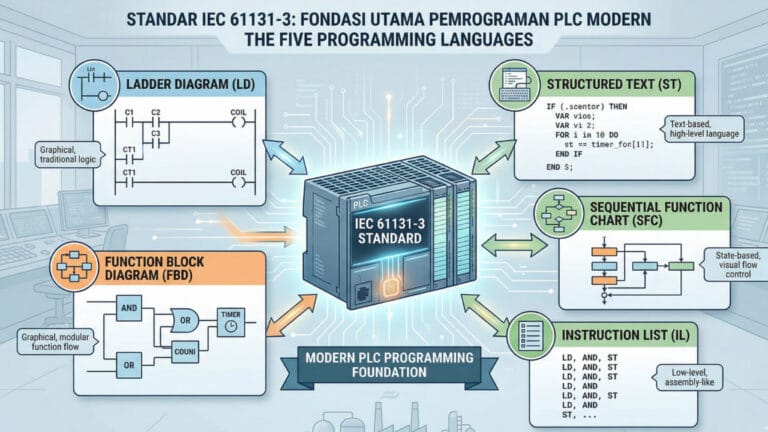
Industrial automation is moving fast. But one thing remains the foundation for every engineer: the ability to program a Programmable Logic Controller (PLC). If you imagine a PLC as the “brain” of a factory, then IEC 61131-3 is the international grammar. It ensures that the brain communicates effectively, structurally, and universally.
At Folks Automation, we often see technical teams struggling to migrate between PLC brands. This usually happens because they rely on only one specific language. This is where the IEC 61131-3 standard comes as the solution. This article will dive deep into why this standard is crucial, the types of languages involved, and its real-world implementation.
What is the IEC 61131-3 Standard and Why Does It Matter?
IEC 61131-3 is part of the international standard for programmable controllers. It defines the software architecture and the set of PLC programming languages according to the IEC 61131-3 standard. Before this, every vendor (like Siemens, Rockwell, or Schneider) had unique ways that were often incompatible with each other.
We see IEC 61131-3 as the “English” of the industrial world. Standardizing your workflow allows for:
- Code Portability: Easily move program logic from one device to another.
- Reduced Training Costs: Engineers only need to learn one standard to master various PLC brands.
- Efficient Debugging: A neat structure makes it easier to track errors.
The 5 PLC Programming Languages According to the IEC 61131-3 Standard
This standard offers five languages divided into two main categories: Graphical and Textual.
1. Ladder Diagram (LD) – The Timeless Classic
LD is the most popular language. It uses symbols similar to electrical circuit diagrams (relay logic). Ladder Diagram (LD) remains the most widely adopted programming language within the IEC 61131-3 standard, primarily due to its graphical representation that mirrors physical relay logic control systems. This language functions by evaluating logic from left to right and top to bottom, essentially creating a structured execution flow that replicates the physical switching of electromechanical components. The syntax is composed of “rungs,” where a series of contacts representing input conditions—such as sensors, switches, or internal memory bits—must satisfy specific logical states to energize an output or a coil.
The core strength of Ladder Diagram lies in its intuitive nature for personnel transitioning from traditional hard-wired control panels to programmable logic controllers. Because the visual layout of LD directly maps to standard electrical wiring schematics, it significantly reduces the learning curve for maintenance engineers and technicians familiar with relay-based troubleshooting. By providing a clear, visible link between the PLC program and the actual field wiring, LD facilitates rapid diagnostics, allowing operators to trace power flow through the logic rungs to isolate faults or verify operational status in real-time.
2. Function Block Diagram (FBD) – Visual Logic Flow
FBD represents functions as boxes connected by signal lines. Function Block Diagram (FBD) is a graphical programming language defined by the IEC 61131-3 standard that utilizes a block-based architecture to represent control logic. In this environment, operations are encapsulated within rectangular blocks, where input variables are processed according to specific algorithms—ranging from simple Boolean logic gates to complex mathematical calculations or PID control loops—before the resulting output is transmitted to subsequent blocks or physical devices. The execution flow is determined by the interconnected signal lines, providing a structured and transparent view of data dependencies throughout the control system.
The primary advantage of FBD lies in its capability to handle complex process control and continuous signal processing with high efficiency. By consolidating intricate functions into reusable, modular blocks, FBD allows engineers to manage sophisticated automation tasks without the visual clutter associated with extensive relay-logic networks. This modularity not only promotes cleaner code architecture and easier documentation of process flows but also significantly accelerates the debugging process, as developers can monitor individual block inputs and outputs in real-time to verify the precision of signal transformations within the PLC program.
3. Sequential Function Chart (SFC) – The Flow Conductor
SFC divides large processes into steps and transitions. Sequential Function Chart (SFC) is a high-level programming language structured by the IEC 61131-3 standard, specifically designed to organize complex operational sequences into distinct steps and transitions. The architecture functions by enabling the program to execute a series of actions only when the preceding step has completed and its associated transition condition—a logical statement verifying inputs or timers—has been satisfied. This hierarchical approach enforces a deterministic execution flow, ensuring that every state of the machine is accounted for, which is critical for managing multi-stage manufacturing cycles or batch processes that require strictly timed operations.
The primary technical strength of SFC is its capacity to provide a clear, high-level overview of the control system’s state machine, which significantly simplifies the management of complex logic that would be unwieldy in ladder-only environments. By decoupling the sequencing logic from the underlying control actions, SFC facilitates better modularity, allowing engineers to focus on the overall process flow while embedding specific sub-routines or blocks within each step. This structure enhances maintainability and reduces the time required for troubleshooting, as developers can instantly identify the exact step or transition where a process has stalled by monitoring the active state within the PLC environment.
4. Structured Text (ST) – The Power of Modern Programming ST is a text-based language very similar to C, Pascal, or Python. Structured Text (ST) is a high-level, text-based programming language defined by the IEC 61131-3 standard, which provides a syntax remarkably similar to conventional programming languages such as Pascal, C, and Python. Unlike graphical languages, ST utilizes a structured command-based format that allows developers to write complex algorithms, nested loops, and intricate mathematical operations within a compact and readable code block. This language is particularly effective for executing high-level data processing, such as scaling analog inputs, managing arrays, or implementing advanced algorithmic calculations, which can be cumbersome and inefficient to represent through graphical programming environments.
The technical superiority of Structured Text emerges in its ability to handle complex decision-making and data manipulation with absolute precision and efficiency. By providing developers with the full flexibility of traditional software development tools including conditional statements, iterative loops, and modular function calls ST enables the creation of sophisticated control logic that is both highly portable and easy to document. For industrial applications requiring intense computational power or extensive data handling, ST serves as the primary language for implementing robust, scalable, and maintainable software architectures that satisfy the rigorous demands of modern automation systems.
5. Instruction List (IL) – The Low-Level Language
IL is similar to Assembly language, based on short command lines. Instruction List (IL) is a low-level programming language within the IEC 61131-3 standard that closely resembles Assembly language, utilizing a sequence of short, mnemonic-based command lines to execute operations. In this format, each line represents a distinct operation, such as loading a value into an accumulator, performing arithmetic calculations, or conditional jumping, which provides granular control over the PLC’s hardware resources. Because IL operates at a level very close to the machine’s native instruction set, it allows for extremely precise memory management and rapid execution times, making it technically suitable for performance-critical tasks where computational overhead must be minimized.
Despite its inherent efficiency, the use of Instruction List has significantly declined in contemporary industrial automation, as its text-based, line-by-line syntax is often considered difficult to read, debug, and maintain compared to higher-level graphical or structured languages. Complex logic implemented in IL can quickly become obscure and prone to errors, increasing the documentation burden for engineering teams during the system’s lifecycle. Consequently, while IL remains a valid part of the IEC 61131-3 standard, it is primarily reserved for specialized, legacy-compatible applications or scenarios where extreme optimization of memory footprint and processor cycle time is the absolute priority.
Case Study: Automated Logistics Sorting System
Let’s look at a real project we handled: A package sorting system based on weight and destination. We combined different PLC programming languages according to the IEC 61131-3 standard for maximum efficiency:
- SFC (Sequential Function Chart): Used as the main structure (Step 1: Entry, Step 2: Weighing, Step 3: Sorting).
- ST (Structured Text): Used to calculate weight averages and process barcodes. Doing math in Ladder is a headache.
- LD (Ladder Diagram): Used for safety and simple motor control. If the Emergency Stop is pressed, the Ladder immediately cuts the power.
Why You Should Switch to the IEC 61131-3 Standard Now
- Investment Security: Your business logic won’t be locked into one vendor (Vendor Lock-in).
- Team Collaboration: An engineer in Jakarta can easily understand code written by an engineer in Germany.
- IoT Integration: This standard simplifies data structures, making them ready for modern IT systems and the cloud.
Quick Tips for Success
- Understand Boolean Logic: Master AND, OR, NOT, and XOR first.
- Use the Right Tool: Try software like CODESYS to practice all five languages.
- Documentation is Key: Good code is code that others can read without having to ask the author.
Conclusion The IEC 61131-3 standard brings efficiency, safety, and flexibility to your production floor. Whether you are a student or a plant manager, mastering these languages is a priceless long-term investment.