

3 Examples of PLC Applications in Different Types of Factories

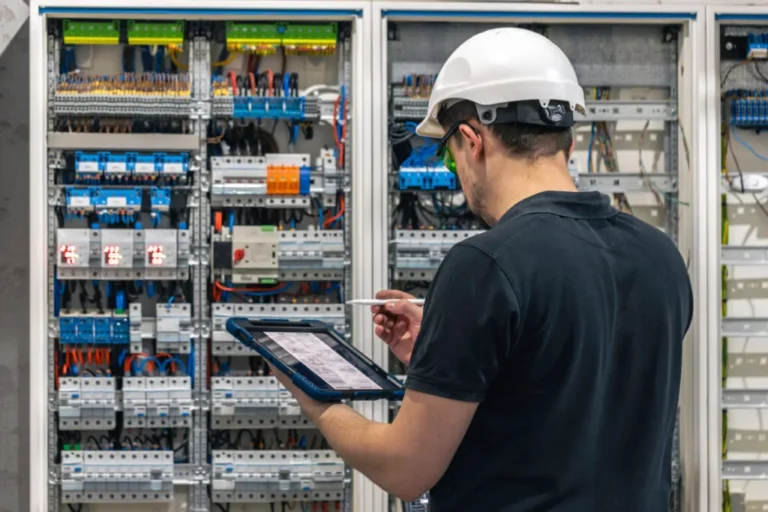
While basic PLC architecture remains consistent, its real-world implementation varies significantly across different sectors. Programmable Logic Controllers (PLCs) adapt to the distinct operational demands, precision standards, and safety requirements of each field. Let’s explore how PLCs drive efficiency, safety, and high-speed automation across key process and manufacturing industries.
Food and Beverage Industry
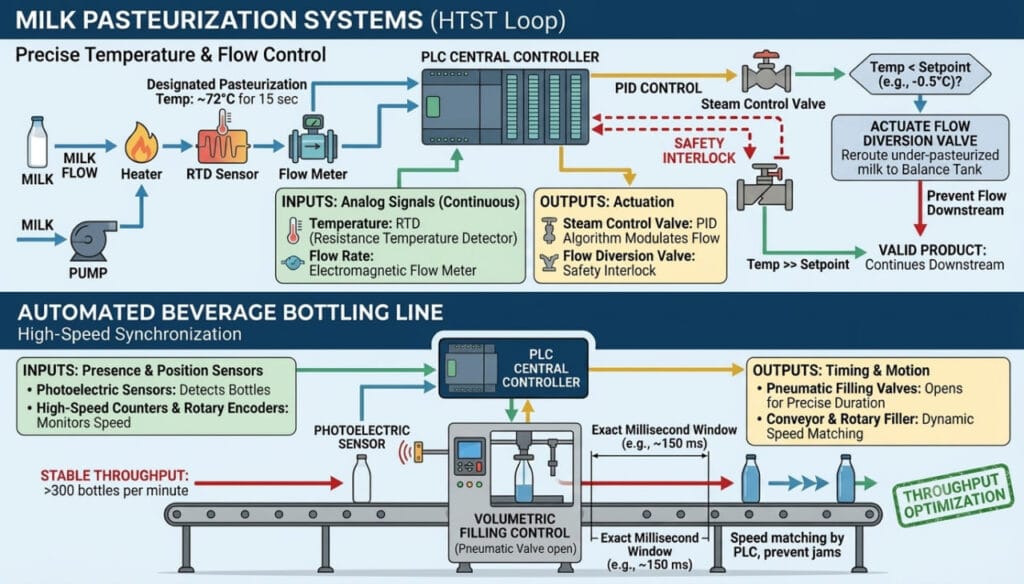
In the food and beverage sector, manufacturing precision directly impacts food safety and yield efficiency. PLCs act as the central controller to standardize high-speed processes where manual intervention is impossible.
For Milk Pasteurization Systems, milk processing plants utilize PLCs to strictly govern High-Temperature Short-Time (HTST) pasteurization loops. The controller processes continuous analog signals from Resistance Temperature Detectors (RTDs) and electromagnetic flow meters. Through Proportional-Integral-Derivative (PID) Control, the PLC runs specific algorithms to modulate steam control valves, ensuring the milk maintains a precise pasteurization temperature of typically 72°C for 15 seconds without scorching. Furthermore, the system relies on Safety Interlocking Logic to guarantee product integrity. If the temperature drops even 0.5°C below the designated setpoint, the PLC instantly actuates a flow diversion valve to reroute the under-pasteurized milk back to the balance tank, effectively preventing contaminated products from moving downstream.
Moving on to Automated Beverage Bottling, timing and synchronization dictate production output in high-speed soft drink lines. PLCs manage the entire sequence from feeding empty bottles to capping and labeling without manual delays. In terms of Volumetric Filling Control, the PLC coordinates with photoelectric sensors to detect bottle presence, then fires high-speed digital outputs to open pneumatic filling valves. It calculates the exact millisecond window required to dispense the precise fluid volume, which successfully eliminates product giveaway. To maximize efficiency, the system focuses on Throughput Optimization by leveraging high-speed counters and rotary encoders. The PLC dynamically matches the conveyor speed with the rotary filler starwheels, which prevents bottle jams, minimizes spillage during fast transitions, and maintains a stable throughput of over 300 bottles per minute.
Manufacturing Industry
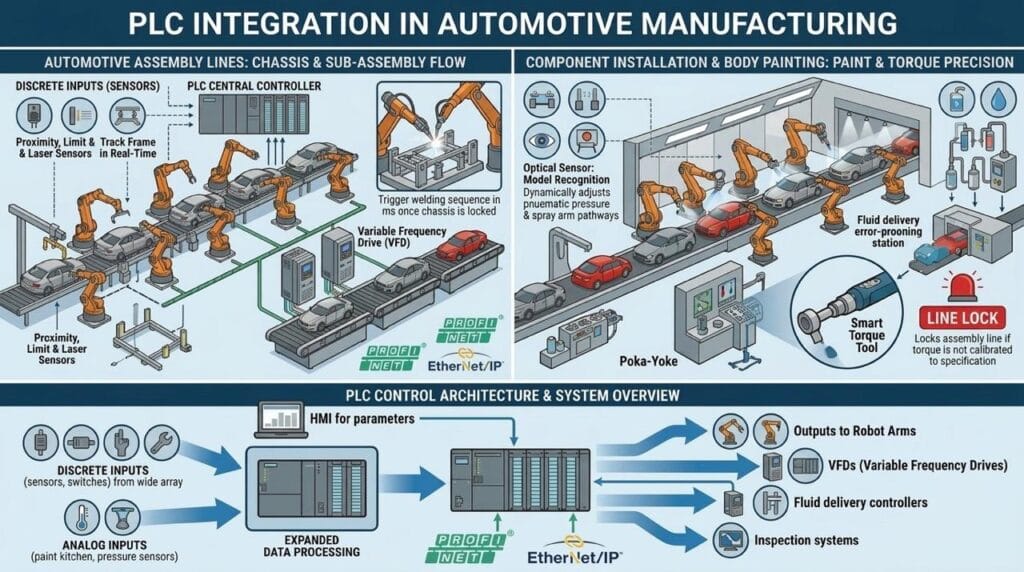
In automotive factories, PLCs are widely used on assembly lines. They control welding robots, In automotive factories, production efficiency and strict assembly tolerances dictate shop floor success. PLCs serve as the primary orchestration layer to synchronize high-speed automation across heavy machinery where human latency would cause bottlenecks.
For Automotive Assembly Lines, manufacturing facilities utilize PLCs to strictly govern the sequential flow of chassis movement and sub-assembly processes. The controller processes hundreds of discrete inputs from proximity switches, limit sensors, and laser positioners to track the car frame in real time. Through Robotic Welding Synchronization, the PLC executes precise interlocking logic to coordinate multi-axis welding arms. It communicates via industrial protocols like PROFINET or EtherNet/IP to trigger the exact millisecond welding sequence once the chassis is locked into the fixture, ensuring structural weld uniformity across thousands of vehicles. Furthermore, the system relies on Automated Conveyor Control to regulate factory throughput. The PLC modulates Variable Frequency Drives (VFDs) to alter conveyor speeds dynamically, preventing line collisions and ensuring that the vehicle body arrives at the component installation zone at the precise cycle time required.
Moving on to Component Installation and Body Painting, timing and position accuracy are critical to maintaining consistent paint finish and mechanical torque compliance. In terms of Automated Body Painting, the PLC coordinates with specialized paint kitchen controls and electrostatic spray reciprocating machines. It processes data from optical sensors to detect the specific vehicle model type, then dynamically adjusts the pneumatic fluid delivery pressure and spray arm pathways to ensure uniform paint thickness without overspray. To finalize the process, the system focuses on Assembly Error Proofing (Poka-Yoke) by integrating the PLC with smart torque tools and vision systems during component installation. The PLC locks the assembly line if a bolt is not torqued to the exact calibrated specification, successfully eliminating human assembly errors and securing rigid quality assurance before the vehicle rolls off the final inspection deck.
Chemical Industry
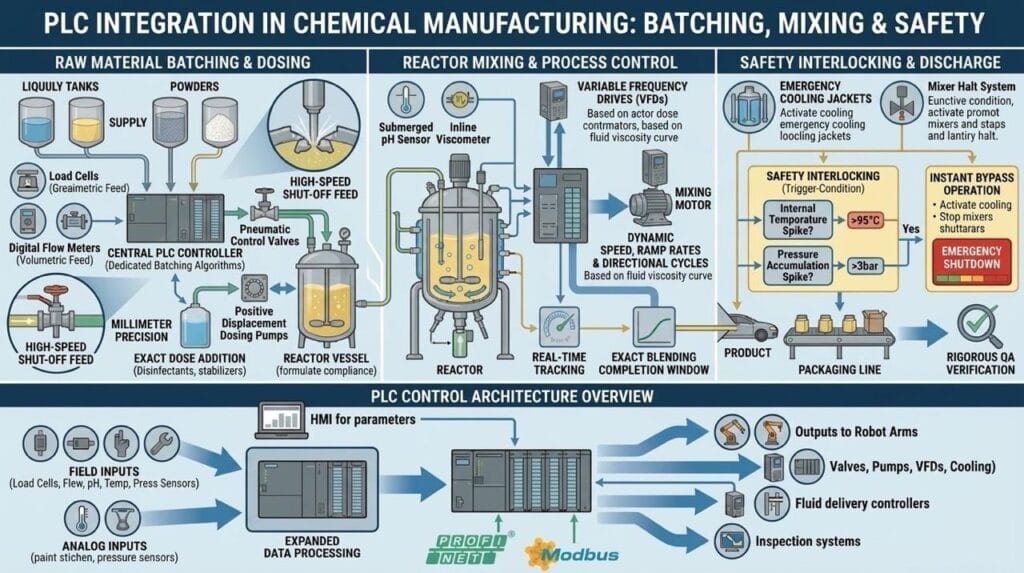
In the chemical manufacturing sector, achieving precise batch consistency and maintaining operational safety are the primary benchmarks for production success. PLCs function as the core automation foundation to regulate raw material dispensing, exothermic monitoring, and multi-stage blending sequences where minor human calculation errors could ruin entire product batches or trigger hazardous thermal runaways.
For Automated Chemical Batching and Dosing, processing facilities utilize PLCs to strictly govern the volumetric and gravimetric delivery of liquid and powdered raw materials into the reactor vessel. The controller processes high-precision signals from load cells mounted beneath the mixing tanks and digital flow meters attached to the supply lines. Through Precision Valve and Pump Modulation, the PLC executes dedicated batching algorithms to control pneumatic control valves and positive displacement dosing pumps. It triggers high-speed digital outputs to shut off the water feed valves the exact millisecond the target volume is reached, then activates specific chemical dosing pumps to inject active cleaning agents, stabilizers, or disinfectants down to the exact milliliter, effectively eliminating raw material waste and guaranteeing strict formulation compliance.
When looking at the operational side of Reactor Mixing and Process Interlocking, rotational speed and real-time parameter tracking dictate the molecular uniformity of the final chemical compound. In terms of Agitation and Blend Control, the PLC communicates with Variable Frequency Drives (VFDs) to manage the mixing motor speed, ramp rates, and directional cycles based on the specific viscosity curve of the fluid. The controller continuously samples data from submerged pH sensors and inline viscometers to determine the exact blending completion window. To finalize the run, the system relies on Safety Interlocking and Automated Discharge to secure the production environment. If pressure accumulation or internal temperatures spike beyond the designated safe threshold during agitation, the PLC instantly bypasses standard operations to actuate emergency cooling jackets and halt the mixers, successfully preventing industrial accidents and verifying rigorous quality assurance before the blended chemical is discharged to the packaging line.
Palm Oil Industry
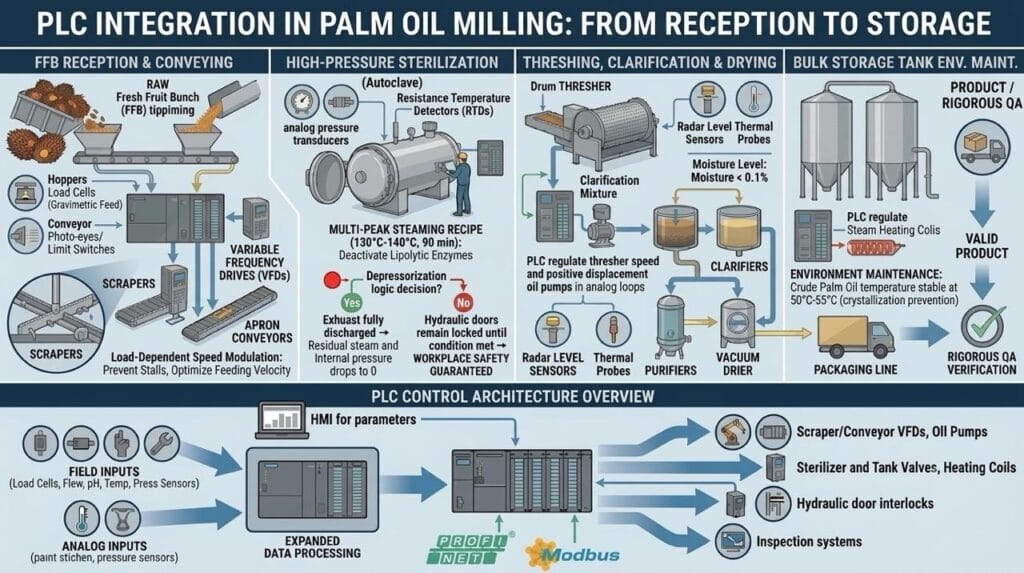
In industrial palm oil milling, maintaining high extraction rates and minimizing Free Fatty Acid (FFA) accumulation depend entirely on tight process control. PLCs serve as the primary automation backbone to govern thermal application, mechanical separation, and material transfer sequences across the entire milling floor, where production delays directly lead to rapid crop degradation and severe oil quality loss.
For Fresh Fruit Bunch (FFB) Reception and Conveying, milling facilities utilize PLCs to strictly govern the intake and distribution of raw crops from tipping platforms to the sterilization cages. The controller processes continuous digital signals from position limit switches, photo-eyes, and heavy-duty load cell weight transmitters beneath the hoppers. Through Load-Dependent Conveyor Optimization, the PLC executes precise speed modulation algorithms using Variable Frequency Drives (VFDs) to control scrapers and apron conveyors. The controller automatically alters the mechanical throughput based on real-time motor torque feedback, preventing conveyor stalls during heavy crop drop-offs, reducing mechanical wear, and maintaining an optimal feeding velocity into the downstream processing zones.
Turning to High-Pressure Fruit Sterilization, steam penetration dynamics and strict pressure curves dictate the efficiency of subsequent oil separation. In terms of Automated Vessel Thermal Control, the PLC coordinates with analog pressure transducers and Resistance Temperature Detectors (RTDs) inside the horizontal or vertical autoclaves. The controller executes pre-programmed multi-peak steaming recipes, opening pneumatic steam inlet valves to hold temperatures at precisely 130°C to 140°C for up to 90 minutes to deactivate lipolytic enzymes. The system relies on Sequential Interlocking and Depressurization Logic to ensure workplace safety. The PLC prevents the hydraulic sterilizer doors from opening until the exhaust blowdown valves have fully discharged residual steam and internal pressure drops down to zero, successfully protecting operators and preparing the softened fruit for the next phase.
Looking downstream at the Threshing, Clarification, and Storage Process, mechanical speed consistency and temperature stability are vital to secure final yield purity. For Mechanical Threshing and Clarification, the PLC modulates the rotational speed of the rotary drum thresher to maximize fruit-bunch separation while controlling positive displacement oil pumps via analog loops to regulate the flow of crude oil mixtures into clarification tanks. The controller constantly samples data from radar level sensors and thermal probes inside the oil purifiers and vacuum driers to maintain a moisture level below 0.1%. To complete the production loop, the system manages Bulk Storage Tank Environment Maintenance by regulating steam heating coils within the massive storage silos, keeping the crude palm oil consistently between 50°C and 55°C to prevent crystallization and solidify strict quality standards before final shipment.
Marine and Shipbuilding Industry
In modern maritime engineering, vessel stability and propulsion reliability dictate operational safety across open ocean routes. PLCs function as the ruggedized automation foundation to govern fluid dynamics, thermal dissipation, and machinery synchronization, where localized system failures could jeopardize crew safety or cause catastrophic mechanical damage to critical shipboard infrastructure.
For Ballast Tank Monitoring and Vessel Stability, deep-sea vessels utilize marine-grade PLCs to strictly govern the distribution of seawater across multi-compartment tank networks. The controller processes continuous analog signals from hydrostatic pressure transmitters, radar level sensors, and digital inclinometers to calculate the ship’s real-time trim, list, and draft. Through Automated Ballast Pump Control, the PLC executes dedicated hydraulic balancing algorithms to manage high-capacity centrifugal pumps and reversible flow networks. The controller triggers precise digital outputs to actuate pneumatic butterfly valves the exact millisecond a specific weight displacement is required, dynamically shifting metric tons of seawater between port and starboard tanks to counteract uneven cargo loading or severe wave action, effectively securing optimal vessel equilibrium and reducing structural hull stress.
Shifting focus to Main Propulsion Engine Cooling Systems, temperature stability and rapid heat exchange are vital to prevent thermal stress on heavy-duty marine diesels. In terms of Closed-Loop Jacket Water Cooling, the PLC coordinates with dual-redundant Resistance Temperature Detectors (RTDs) and inline electromagnetic flow meters stationed at the engine block inlet and outlet. The controller executes continuous PID loops to modulate 3-way thermostatic mixing valves, blending cold seawater from the sea chest with internal freshwater jackets to maintain the engine at a strict operating window of typically 80°C to 85°C. To secure the machinery space, the system relies on Emergency Thermal Interlocking and Auxiliary Pump Activation to handle extreme thermal loads. If the primary cooling loop fails and engine temperatures spike beyond the designated maximum threshold, the PLC instantly bypasses standard automation to fire up standby secondary seawater pumps and sound localized engine room alarms, successfully preventing catastrophic piston seizing and verifying rigid mechanical reliability before the vessel suffers a complete loss of propulsion.
Why Factories Use PLCs
PLCs serve as the central control unit of modern factory automation. They connect sensors, machines, and control devices into one integrated system that operates automatically, reliably, and continuously.
Conclusion
Without PLCs, industrial processes would rely heavily on manual operators, making them slower, more prone to errors, and harder to control consistently. PLCs allow factories to operate faster, more accurately, more safely, and more efficiently through automation.
Maximize Your Plant’s Efficiency Today
Optimizing a complex industrial system requires tailored automation engineering. If you are looking to upgrade your legacy machinery, integrate robust PLC architectures, or eliminate production bottlenecks, our engineering team is ready to assist. Consult with Our Automation Experts on WhatsApp to discuss your specific factory floor requirements and secure a reliable control system strategy.