

Understanding Automation Synergy: What is SCADA and Its Relationship with PLC?

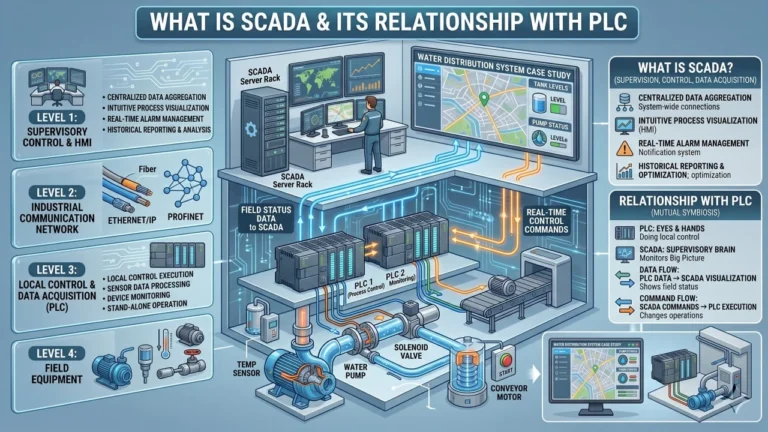
In the Industry 4.0 era, efficiency is a necessity, not just an option. Having helped industries transition to smart automated systems for years, we frequently encounter a fundamental question from students and young technicians: “Is a PLC alone not enough? Why do we need SCADA?”
This article fully explores their connection through a practical industrial perspective.
1. Automation Philosophy Basics: Distinguishing the Brain and Eyes
Before discussing technical details, let’s use a simple analogy. Imagine a factory as a human body.
- PLC (Programmable Logic Controller) acts as the spinal cord and muscles. It works reflexively, operates fast, and handles specific instructions. If your hand touches a hot surface, the PLC commands it to pull away immediately without overthinking.
- SCADA (Supervisory Control and Data Acquisition) serves as the brain and eyes. It monitors body temperature, regulates walking speed, and records activity history to ensure long-term health.
What is a PLC?
A PLC is hardware designed to operate in harsh industrial environments. It receives input from sensors, processes it using ladder diagram logic, and delivers output to actuators or motors.
What is SCADA?
SCADA is top-level software used to remotely control, monitor, and analyze entire industrial processes. SCADA does not replace the PLC; it sits above it.
2. Symbiotic Relationship: How Do SCADA and PLC Work Together?
SCADA and PLC share a harmonious hierarchical relationship. The PLC operates at the field level, while SCADA operates at the supervisory control level.
How They Interact:
- Data Collection: The PLC gathers raw data from machines (temperature, pressure, item count).
- Communication: The PLC sends this data to the SCADA server via communication protocols (such as Modbus, Profibus, or Ethernet/IP).
- Visualization: SCADA converts complex PLC numbers into human-readable graphics on an HMI monitor.
- Intervention: Operators issue commands through the SCADA screen (e.g., “Turn off Pump 2”), which SCADA sends back to the PLC for execution. To see exactly how these commands run on the factory floor, engineers often study [automotive industry PLC program examples].
3. Why Can’t Industries Rely Solely on PLCs?
Many beginners think a PLC and a small HMI screen are enough. However, managing large-scale manufacturing systems reveals PLC limitations that only SCADA can solve:
- Data Storage (Historian): PLCs have limited memory. SCADA stores data for years for future analysis.
- Remote Access: SCADA allows plant managers to monitor machine conditions from headquarters or smartphones, eliminating the need to stand in front of the machine.
- Alarm Management: SCADA classifies thousands of alarms from hundreds of different PLCs and prioritizes them.
- Automated Reporting: SCADA generates crucial daily or monthly automated reports for company management.
4. Industrial Challenge: From Reactive to Proactive
We often see companies suffer massive losses due to sudden machine downtime. This separates companies using PLCs for basic operations from those leveraging SCADA for advanced strategies. One of the most advanced implementations of this synergy is Predictive Maintenance.
5. Case Study: Predictive Maintenance Implementation on Industrial Pump Systems
Let’s look at how our client, a water treatment plant, transformed from a manual to a predictive system.
Initial Condition (Reactive) Initially, they only used PLCs to turn pumps on and off. Problems arose when a pump motor bearing wore out and broke at midnight. The machine died, production stopped, and repair costs swelled as the damage spread.
SCADA & PLC-Based Solution We integrated additional vibration and temperature sensors into the PLC, sending real-time data to the SCADA system.
- Pattern Recognition: SCADA recorded that whenever motor temperature exceeded 70°C alongside high-frequency vibrations, failure usually occurred within 48 hours.
- Early Notification: When SCADA detects this pattern again, it warns technicians: “Pump A shows bearing wear. Lubricate within 12 hours.”
- Result: Technicians perform repairs during break times without stopping production. Bearing replacement costs only 10% of replacing the entire motor.
6. Key Components in a SCADA-PLC System
If you are new to this field, you must understand this entire ecosystem:
- MTU (Master Terminal Unit): The central SCADA server.
- RTU (Remote Terminal Unit) or PLC: The “hands” performing physical work on site.
- HMI (Human Machine Interface): The graphical interface where humans interact with machines.
- Communication Network: The connecting medium (fiber optic cables, radio, or industrial Wi-Fi).
7. Future Outlook: SCADA, PLC, and IIoT
The industrial world continuously evolves towards IIoT (Industrial Internet of Things). Will SCADA go extinct? We believe not. SCADA is transforming to become more open and cloud-based.
Understanding how to integrate PLCs into SCADA systems is a highly valuable skill set for students and young professionals. You learn not only to program “On/Off” logic but also how to manage data into profitable information.
Conclusion The synergy between the PLC as the executor and SCADA as the supervisor is the backbone of modern industry. Without a PLC, the industry loses its physical strength; without SCADA, it loses its intelligence.
If you are starting a career in this field, begin by mastering PLC logic, but do not stop there. Learn how SCADA visualizes and analyzes PLC data. This is the key to becoming a highly sought-after engineer in the future.
Ready to take efficiency to the next level? Proper implementation starts with understanding the strong relationship between your industry’s brain and muscles.