

Why the PLC is the “Brain” Behind Automotive Production Lines

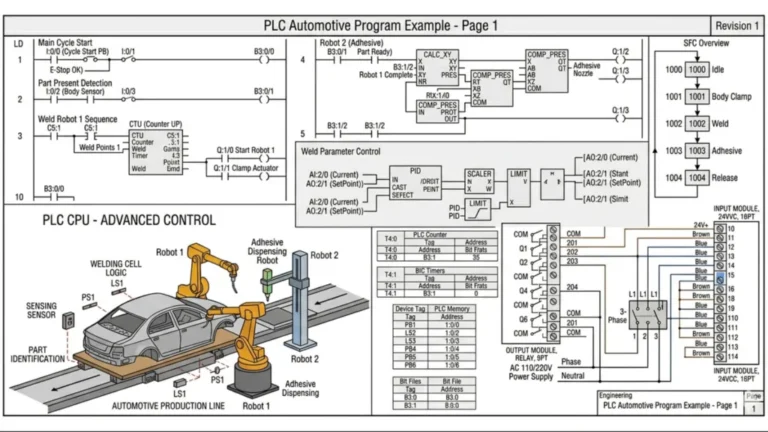
In the modern automotive manufacturing landscape, the production line functions much like a grand, complex orchestra. Every robotic arm, conveyor belt, and sensor serves as an individual instrument, but they require a central conductor to create harmony rather than chaos. This is where the Programmable Logic Controller (PLC) acts as the essential brain of the operation, ensuring that every movement is perfectly timed and synchronized. Without this high-level coordination, the sheer speed of automotive assembly would be impossible to manage.
Engineers rely on the PLC not just for basic automation, but for its ability to handle high-speed data processing. In a sector where milliseconds determine production efficiency, the PLC regulates cycles with unmatched precision, ensuring that raw materials move through the assembly line at a constant, optimized pace. Beyond speed, these controllers serve as the primary safety gatekeeper. By integrating sophisticated interlock systems directly into the control logic, the PLC actively monitors for potential hazards, immediately halting machinery if a sensor detects an operator near a dangerous zone to prevent workplace injuries.
Furthermore, the true power of the PLC lies in its inherent scalability, which is vital for the automotive industry’s rapid evolution. As car manufacturers frequently update vehicle designs or introduce new models, they cannot afford to replace their entire hardware infrastructure every few years. Because modern PLCs are programmable, engineers can adapt the production line to new specifications simply by modifying the software code. This flexibility allows manufacturers to remain competitive and responsive to market changes while significantly reducing downtime and capital expenditure.
Basic Structure and Logic of Automotive PLC Programs
Fundamentally, we compare PLC programs to recipe instructions. If the system prepares “ingredient A” and reaches “temperature B”, it executes “step C”. In technical terms, we use Ladder Diagrams (LD).
1. Interlocking Logic (Machine Safety)
At the heart of industrial safety lies the fundamental logic of interlock systems, which serves as the primary barrier between automated machinery and human operators. Before a welding robot initiates its high-precision task, the Programmable Logic Controller (PLC) must perform a rigorous safety verification. The system essentially performs a “handshake” check: it confirms that the protective cell door is securely latched—monitored via a door sensor—and verifies that the workspace is entirely clear of personnel through the use of light curtains or presence sensors. Only when these safety conditions are met does the controller issue the command to permit robot operation.
This logic is a classic implementation of a fail-safe environment, where the absence of a “human present” signal is just as critical as the presence of a “door closed” signal. In practice, the PLC continuously scans these inputs; if at any point the door is opened or the light curtain detects an intrusion, the output signal is immediately revoked, forcing the robot into a controlled stop. By codifying these safety protocols into the PLC logic, manufacturers eliminate human error from the equation, ensuring that the production line operates under a rigid, automated safety standard that prioritizes personnel protection without sacrificing process efficiency.
2. Conveyor Control with Inverters (VFD)
The seamless transfer of car bodies between assembly stations relies heavily on the precise control of conveyor systems. In the automotive industry, simply moving a chassis from point A to point B is not enough; the process must be handled with extreme care to prevent structural stress or misalignment. This is where PLC programming becomes critical, specifically in managing the ramp-up and ramp-down profiles of the drive motors. By carefully regulating the acceleration and deceleration phases, the PLC ensures that the movement remains fluid, effectively eliminating sudden jerks that could cause the car body to vibrate or shift off-center during transit. For those interested in the foundational logic behind these automated processes, our article on What is PLC Ladder Diagram? A Simple Guide to Industrial Programming provides a clear breakdown of how these instructions are visually constructed.
Beyond merely moving components, this controlled motion plays a vital role in maintaining high-quality production standards. Any abrupt motion can lead to assembly errors at downstream stations, such as inaccurate welding or misaligned part installation. Through sophisticated frequency control or motion profiles integrated into the PLC, engineers can tailor the torque delivery to the mechanical load, ensuring a stable ride for the vehicle body throughout the entire production line. This level of granular control not only extends the mechanical lifespan of the equipment but also significantly reduces the need for manual realignments, directly contributing to a more efficient and reliable manufacturing cycle.
3. Electronic Poka-Yoke (Error-Proofing)
The integration of Poka-Yoke, or error-proofing systems, within PLC architecture represents a shift from reactive quality control to proactive defect prevention. In a sophisticated assembly environment, the PLC functions as a gatekeeper; for instance, if an operator fails to secure a bolt to the precise torque specification—verified by a digital torque wrench—the system effectively locks the conveyor. By preventing the component from advancing to the next station until the error is rectified, the PLC ensures that no defective product moves further down the line, thereby containing quality issues at the source.
To visualize the impact of this automation, consider a typical door panel welding cell. A manufacturing facility once struggled with inconsistent manual welding, resulting in a 5% reject rate—a significant drain on both throughput and profitability. The challenge was clear: the process required a level of repeatability that human labor alone could not sustain. By implementing a robotic welding cell controlled by a PLC, the factory established a system where every weld point is guaranteed to receive consistent heat and maintains absolute positional accuracy. This transition not only eliminated the variability of manual craftsmanship but also turned a high-scrap process into a streamlined, high-yield operation.
Our PLC Program Solution We designed a program architecture dividing the process into several sequences:
- Clamping Stage: The PLC receives input confirming the panel placement. The output, a pneumatic valve (Solenoid Valve), locks the panel.
- Validation Stage: Proximity sensors ensure precise panel positioning (Tolerance < 0.5mm).
- Robot Communication Stage: The PLC sends a “START” signal to the welding robot controller via communication protocols (such as PROFINET or EtherNet/IP).
- Monitoring Stage: The PLC monitors the welding electrical current while the robot operates. If the current drops below the threshold, the PLC stops the system and triggers the alarm light (Andon Light).
Final Result
Post-implementation, the error rate dropped below 0.2%, and production speed increased by 30% per hour. This demonstrates the power of well-structured PLC logic.
Important Components in Modern PLC Programming We recommend prioritizing these elements in your program structure when developing systems:
Using Timer and Counter Instructions
- Timer (T): Pausing the cooling process after welding or painting.
- Counter (C): Counting produced units per shift or triggering routine maintenance schedules (Maintenance Alert) after the machine reaches a specific cycle count.
Fault Handling Do not strictly program the machine to run; program it to know how to stop during issues. We include specific blocks to handle Emergency Stops and sensor failure detection to prevent severe mechanical damage.
HMI (Human Machine Interface) Integration An effective PLC program communicates with operators. We design memory addresses (Memory Bits) to display machine status visualizations on the HMI screen, helping operators pinpoint bottlenecks without opening a programming laptop.
Simple Analogy: The PLC as the Human Nervous System To simplify, view the PLC as your brain.
- Sensor (Input): Your eyes and skin. If your skin feels heat (Input), the brain processes that information.
- Program (Logic): Your instinct. “If it is extremely hot, pull your hand away”.
- Actuator (Output): Your arm muscles moving away from the heat. In the automotive industry, sensors act as “eyes” tracking the car frame’s position, and drive motors act as “muscles” moving it.
Conclusion: Steps to Becoming an Automotive PLC Expert
The automotive world continuously moves toward Industry 4.0. Understanding basic PLC programs forms the foundation, but integrating production floor data into management systems (MES/ERP) represents the future. Start by understanding Interlock and Sequence logic if you are a beginner. Focus on optimizing code to make it modular and easier to troubleshoot if you are experienced.
We believe precise logic guarantees efficiency. If you face specific control system challenges in your factory, remember every code line you write invests in long-term production smoothness.
Want to learn more about integrating PLCs with robotic systems? Contact our technical team on whatsapp number +6282316003400 to consult on the optimal automation strategy for your production line.