

PLC vs Microcontroller: Which One Is Right for Your Automation System?

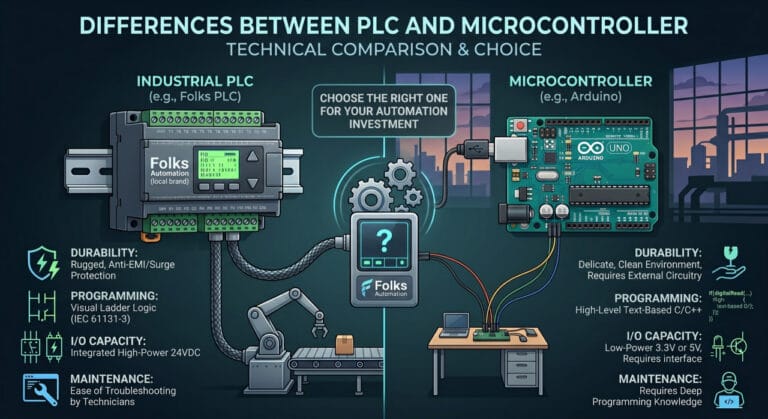
Designing a control system for a production line presents a critical question: should you use an industrial-standard Programmable Logic Controller (PLC), or opt for a significantly cheaper microcontroller (such as Arduino or Raspberry Pi)?
This question arises frequently because modern microcontrollers now possess high computing power. However, computing power alone is insufficient to survive the factory floor environment. Choosing the wrong hardware during the design phase will lead to costly machine downtime. This article examines the technical and objective differences between PLCs and microcontrollers, helping you make the right decision for your industrial automation investment.
The Root of the Difference: Design and Purpose
The fundamental difference between a PLC and a microcontroller lies not only in its physical packaging but in how their “brains” process information. Let’s look at this from the perspective of computing architecture.
A microcontroller is a single Integrated Circuit (IC), a mini-computer that includes a CPU, memory, and I/O on one chip. Its basic design is General-Purpose Computing.
Meanwhile, a PLC is an integrated computing system designed with one absolute goal: Deterministic Control. In the IEEE Transactions on Industrial Informatics journal, a deterministic system is defined as a system that always responds to inputs within a precise and predictable time frame.
Technical Analysis: PLC vs. Microcontroller
To understand what you need, we must dissect the technical specifications of both in three critical aspects:
1. Industrial Durability
The factory floor is not a comfortable laboratory table. On the production floor, large machines, Variable Frequency Drives (VFDs), and induction motors create “storms” of electrical and physical interference. Here is how both devices respond:
Microcontroller (Lack of Built-in Protection)
Vulnerable to EMI and RFI: Components like Arduino or Raspberry Pi are designed for electrically clean environments. In a factory, Electromagnetic Interference (EMI) from welding machines or VFDs can easily induce stray currents into microcontroller cable paths, causing the system to reset, freeze, or read false sensor signals.
No Galvanic Isolation: Microcontrollers operate at very low voltage levels (usually 3.3V or 5V DC). The main chip connects directly to I/O pins. If a short circuit or power surge occurs from a 24V sensor in the machine area, that lethal current will immediately penetrate and burn out the microcontroller’s brain.
Temperature and Dust: Commercial microcontroller boards are generally exposed without extra protection. Carbon dust accumulating in the factory or high humidity levels easily trigger micro short circuits between pins on the circuit board.
PLC (Robust Architecture)
Built-in Optocouplers: This is a PLC’s primary line of defense. Light-based circuits (optocouplers) separate every Input and Output terminal on the PLC from the logic processor. This physical separation ensures that if an extreme voltage spike occurs in the machine area, damage is restricted to the outer I/O module; the main processor remains safe and operational.
Noise-Resistant Power Supply: PLC electrical circuits integrate internal filters that aggressively dampen voltage fluctuations and eliminate high-frequency noise before electricity hits the logic circuits. You no longer need to struggle with soldering additional capacitors or voltage regulators.
Closed and Fanless Physical Design: Industrial PLCs are designed to be fanless to prevent metallic dust, water vapor, or chemicals from being sucked into components. Furthermore, conformal coating layers on PLC Printed Circuit Boards (PCBs) protect them from corrosion and damage caused by extreme mechanical vibrations.
2. Programming Language and Open Standards
How you program a device determines how quickly you can perform troubleshooting when a machine fails in the middle of the night.
- Microcontroller: Uses high-level text languages like C, C++, or Python. These are flexible for software developers but are very difficult for maintenance technicians on the factory floor to read quickly.
- PLC: Refers to the international standard IEC 61131-3. PLCs use visual languages like Ladder Diagram (LD) or Function Block Diagram (FBD). If a sensor issue occurs, factory technicians can view logic flow visually (real-time monitoring) and isolate the problem in minutes.
3. Scalability and I/O Modules (Input/Output)
Factory needs are constantly evolving. Your system must be able to keep up.
- Microcontroller: Features I/O pins with very small current capacity (usually 5V or 3.3V, in the milliampere range). You need many additional components, such as relay modules, to drive standard industrial devices (24VDC or 220VAC).
- PLC: Modular by nature. You can easily add digital, analog, or temperature control I/O expansion modules. PLC outputs directly support industrial voltage (24VDC) and are capable of driving contactors or solenoid valves directly.
Conclusion: When to Use Which?
Use a Microcontroller if you:
- Are designing mass-market commercial products (such as consumer electronics).
- Are building laboratory-scale prototypes.
- Have extreme space limitations (device size in centimeters).
Use a PLC if you:
- Are controlling production machines, conveyors, or factory systems.
- Require a system that can stay powered on for months without restarting.
- Desire ease of maintenance by standard technicians.
Bridging Your Industrial Needs with Folks Automation
Many industrial players in Indonesia often resort to microcontrollers simply because they are deterred by the high costs of imported PLCs and the slow technical support that comes with them. This is a significant gap in our automation market.
Folks Automation is here to bridge that divide. As Indonesia’s first local PLC manufacturer, Folks Automation designs industrial-standard control system architectures that are rugged enough for the harshest factory environments, all while maintaining local pricing and accessibility.
We understand that choosing hardware isn’t just about reading specifications on paper. It’s about ensuring your machines run optimally and generate consistent profit. That is why our approach goes beyond just selling products. Folks Automation provides direct consultation to dissect the specific challenges you face. Our engineering team will audit your systems, evaluate your needs—whether it’s complex PID control or specific I/O requirements—and design automation solutions that are truly precise.
Stop guessing between cost-efficiency and system reliability. Let’s discuss your machine control architecture with us. Contact Folks Automation via WhatsApp at +6282114044968 today, and let’s build an automation system that is robust, efficient, and 100% backed by local technology.