

How PLCs Work Together with VFCs

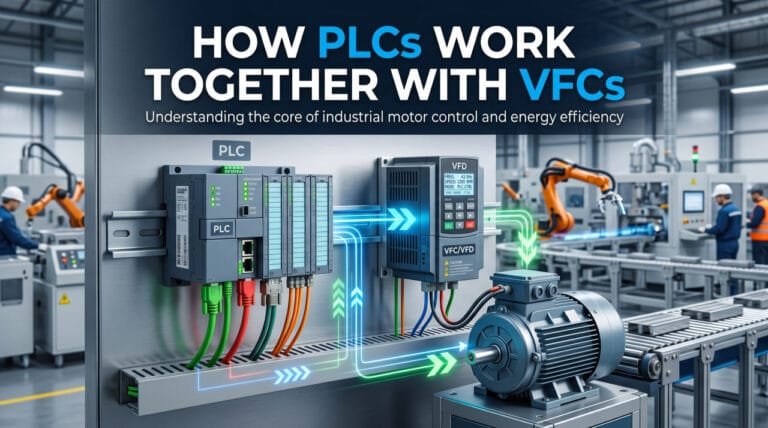
Industrial electric motors consume over 60% of the total energy in a factory. For decades, industries ran these motors using Direct-On-Line (DOL) or Star-Delta systems. This meant the motor only recognized two states: 100% on or completely off. This approach not only wasted electricity but also damaged mechanical components due to torque surges during motor startup.
Modern automation systems solve this issue by pairing two crucial devices. Understanding how PLCs work together with VFCs (Variable Frequency Controllers) is key for factories aiming to achieve maximum energy efficiency and precise operations.
Integration of PLCs and VFCs
A Programmable Logic Controller (PLC) acts as the system’s brain. This device receives data from various field sensors, executes logic algorithms (such as PID—Proportional, Integral, Derivative control), and makes real-time decisions. However, a PLC operates at low currents and voltages. A PLC cannot directly drive heavy-duty motors.
This is where the VFC (frequently called a VFD Variable Frequency Drive) takes on the role of the muscle. The VFC is responsible for manipulating the electrical frequency and voltage supplied to the AC motor. By altering the frequency, the VFC can regulate motor rotational speed (RPM) with high accuracy.
The way PLCs work together with VFCs occurs through a continuous communication loop. The PLC calculates how fast the motor needs to spin based on current conditions, then issues commands to the VFC. The VFC subsequently executes those commands by modifying the electrical waves using Pulse Width Modulation (PWM) techniques.
Data Communication Methods Between PLC and VFC
Communication between these two devices generally occurs through two primary methods:
- Analog Signals (Conventional): The PLC sends voltage (0-10V) or current (4-20mA) to the VFC’s input terminals. For example, a 4mA signal means the motor stops (0 Hz), while 20mA means the motor rotates at maximum speed (50/60 Hz). While simple, this method is susceptible to electromagnetic noise interference on the factory floor.
- Digital Protocols (Modern Automation): Communication uses network cabling with protocols such as Modbus RTU, Profinet, or Ethernet/IP. This method is far superior. The PLC does not merely send speed commands; the VFC can also transmit return data (feedback) back to the PLC. Information like motor current consumption, VFC temperature, and error codes can be read by the PLC and forwarded to the IoT system.
Case Study: Cooling System Optimization in a Global Data Center
To see its effectiveness, let’s examine an implementation within an HVAC (heating, ventilation, and air conditioning) system at a large-scale data center facility in Northern Europe. Data centers generate extreme heat and require constant cooling.
Under the legacy system, the cooling water pumps (chillers) ran at a maximum speed of 100%, while temperature was regulated using valves that opened and closed. This is akin to stepping firmly on a car’s gas pedal while controlling its speed using the handbrake. Extremely inefficient.
After the facility implemented an integrated automation system, the architecture changed completely:
- Temperature sensors in the server room read the heat increase and sent that data to the PLC.
- The PID algorithm inside the PLC calculated that the room only required 65% cooling capacity to stabilize the temperature.
- The PLC transmitted data packets over the Profinet network to the VFC.
- The VFC immediately lowered the electrical frequency from 50 Hz to roughly 32.5 Hz.
- The water pump slowed down to 65% rotational speed.
When the server load decreased at night, the PLC detected the temperature drop and commanded the VFC to slow the motor down to 30%. The results of this implementation were highly measurable: the facility slashed cooling motor energy consumption by up to 40% and extended the mechanical lifespan of the pumps by eliminating mechanical stress from forcibly closed valves.
Execution and Maintenance Challenges in Indonesia
While the concept is logical, the use of PLCs in industrial automation systems alongside VFCs in Indonesia frequently encounters after-sales hurdles. When digital communication between the PLC and VFC drops, or when the drive experiences an overcurrent fault, factory technicians require immediate analysis.
Unfortunately, the majority of PLCs and VFCs used in Indonesia are foreign brands. When complex integration issues arise, bringing in principal engineers consumes significant time and expense. Just a few days of machine downtime can cost a factory hundreds of millions of rupiahs in losses.
Folks Automation: The New Standard for Local PLCs
Robust industrial infrastructure requires technology that is not only advanced but also supported by a nearby service ecosystem. This is where Folks Automation steps in. As the first locally made PLC company in Indonesia, Folks Automation designs reliable industrial controllers built for tropical manufacturing environments and fully compatible for integration with various VFC brands on the market.
The primary advantage of Folks Automation extends beyond hardware; it lies in a deep understanding of the use of PLCs in industrial automation systems on the ground. Being based in Indonesia, the Folks Automation engineering team cuts through supply chain lead times and technical support bureaucracy. If data communication issues occur between the PLC and your motor system, expert technicians can respond and perform troubleshooting far faster than foreign principals.
Consult Your Factory’s Needs
Integrating a PLC and VFC is more than just connecting cables. It is about designing the right PID algorithms, choosing noise-immune communication protocols, and ensuring VFC data can be pulled into IoT dashboards for predictive maintenance needs.
Do not let motor inefficiencies erode your factory’s profit margins. If you are facing machine synchronization challenges, drive integration issues, or looking to rejuvenate legacy control panels, our experts are ready to help.
Start your journey consultation now. Discuss your automation system challenges directly with the Folks Automation engineering team via WhatsApp at +6282114044968. We ensure solutions that are fit for purpose, budget-logical, and performance-optimized.