

A Brief History of the World’s First PLC

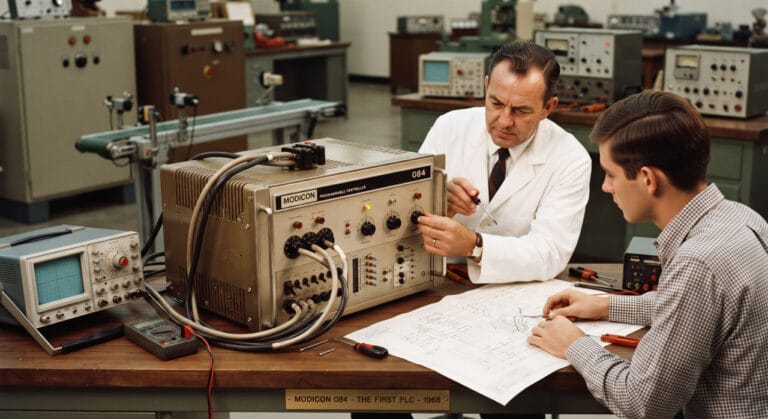
The manufacturing industry in the 1960s operated in a highly mechanical and noisy environment. Large factories, particularly automotive assembly lines, were controlled by thousands of physical relays, timers, and sequencers. These systems had fundamental weaknesses: they were complicated, prone to wear and tear, and required weeks to reconfigure whenever product designs changed.
These challenges prompted Dick Morley and his team to develop the Modicon 084 in 1968. This device became the world’s first Programmable Logic Controller (PLC), successfully replacing rows of mechanical relays with digital programmable logic.
How Does a PLC Work?
Input Components: Sensors / Switches
           |
           ▼
┌─────────────────────────────────────┐
│              PLC UNIT               │
│                                     │
│  ┌─────────┐  ┌─────────┐  ┌──────┐ │
│  │  Input  │─>│ CPU/Mem │─>│Output│ │
│  └─────────┘  └─────────┘  └──────┘ │
└─────────────────────────────────────┘
           |
           ▼
Output Components: Motor / Actuator / Valve
The evolution of PLCs, from simple relay replacements to intelligent control centers, has gone through several important phases:
- 1970s (Logic Standardization Era): The introduction of Ladder Diagram (LD) programming, which adopted symbols from traditional relay schematic diagrams. This visual programming language made it easier for field technicians to translate physical control logic into digital systems. To understand the basic logic instructions used during this era, you can also read our simple guide to PLC operation and AND, OR, NOT logic.
- 1980s (Microprocessor and Compact Design Era): The adoption of microprocessors made PLCs increasingly compact, significantly improved logic execution speed (scan time), and expanded memory capacity.
- 1990s (IEC 61131-3 Standardization Era): The International Electrotechnical Commission (IEC) established standardized PLC programming languages, including Ladder Diagram (LD), Structured Text (ST), Function Block Diagram (FBD), Sequential Function Chart (SFC), and Instruction List (IL).
- 2000s to Present (IoT and Automation Convergence Era): PLCs have evolved into Programmable Automation Controllers (PACs) and IoT-based PLCs. Modern devices can now connect directly to cloud networks, support communication protocols such as MQTT and OPC UA, and process analytical data in real time.
PLC Convergence and Industry 4.0
The needs of modern factories are no longer limited to operating hydraulic cylinders or running electric motors. Today’s major challenges revolve around energy efficiency, predictive maintenance, and data visibility across every level of operations, from the shop floor to the top floor. Today’s PLCs play a crucial role as the bridge between Operational Technology (OT) and Information Technology (IT). This integration allows operational data to be processed directly using Edge Computing algorithms before being transmitted to SCADA, MES, or ERP systems.
| Key Features | Traditional PLC | Modern IoT PLC |
|---|---|---|
| Primary Function | Local sequential logic control | Logic control combined with cloud data processing |
| Network Architecture | Proprietary / Closed Fieldbus | Ethernet/IP, MQTT, OPC UA, Modbus TCP |
| Data Accessibility | Isolated within the factory | Data can be accessed remotely |
| Maintenance | Scheduled and reactive maintenance | Predictive maintenance based on condition analytics |
Automation Challenges in Local Industries
The adoption of automation technology in Indonesia often faces practical challenges. Many medium-sized industries encounter a dilemma when attempting to modernize their existing systems. The initial capital expenditure (CAPEX) for global PLC brands is relatively high. Spare parts are not always readily available, and direct technical support from manufacturers can be slow due to dependence on imported supply chains.
On the other hand, relying entirely on foreign products can slow down technology transfer and technical skill development among local technicians. In reality, automation requirements across domestic manufacturing lines demand fast technical support, flexible logic customization, and predictable maintenance costs.
Folks Automation and a New Era of Locally Made PLCs
Recognizing these technical gaps and operational challenges, Folks Automation emerged as a pioneer of Indonesia’s first locally developed PLC brand. The presence of Folks Automation is not merely an answer to the need for cost efficiency. It also represents a strategic step toward building technological independence in the country’s industrial control sector.
Folks Automation’s product architecture is designed to combine the reliability of industrial PLC logic with the flexibility of modern IoT protocols. This integration makes it easier for system integrators and in-house engineering teams to implement remote monitoring systems without having to completely overhaul their existing automation infrastructure.
Meeting Technical Requirements
Implementing PLCs on production floors requires long-term reliability. Folks Automation focuses on three main pillars:
- Easy Access to Spare Parts: Local availability of units and I/O modules helps reduce downtime caused by delays in importing components.
- Protocol Compatibility: Supporting widely used industrial communication standards such as Modbus and MQTT-based IoT architectures enables seamless integration with analytical dashboards.
- Direct Technical Support: Our local engineering team is ready to provide in-depth technical guidance, from system architecture design to the commissioning stage.
Choosing the right automation architecture requires careful analysis of operational requirements. Whether you are planning to modernize your control system, integrate PLCs into an IoT network, or resolve issues with your existing automation system, Folks Automation provides direct technical consultation to help optimize your production lines. Discover smarter industrial automation solutions with Folks Automation.