

Why Are Modern Factories Switching from Relays to PLCs?

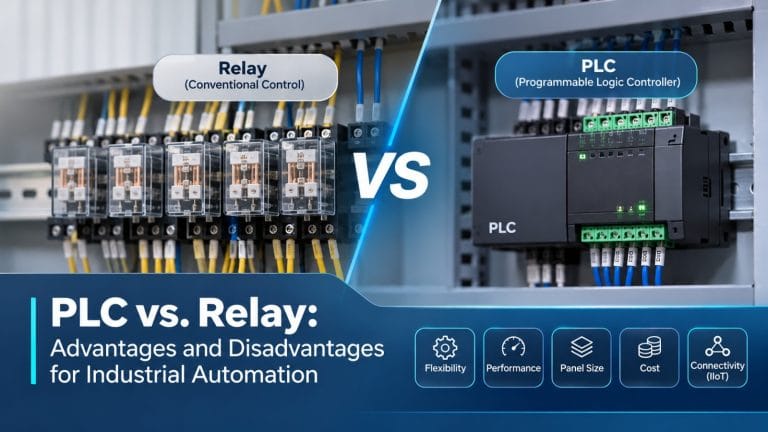
The debate over whether to maintain conventional relay panels or switch to Programmable Logic Controllers (PLCs) is still common in factory engineering departments. Relay-based systems have served as the backbone of industrial automation for decades due to their simplicity. However, increasing demands for efficiency, production flexibility, and modern data integration are forcing industries to reevaluate their existing control system architectures. To determine which system best suits your operational requirements, we need to objectively examine the characteristics, advantages, and technical limitations of each technology.
Understanding the Basic Characteristics of Relay and PLC Systems
Conventional relay control systems operate based on electromechanical principles. When electric current flows through a coil, the resulting magnetic field attracts mechanical contacts, causing them to open or close a circuit. The control logic is built through a sequence of physical wiring (hardwired logic) connecting dozens or even hundreds of physical relays, timers, and counters inside a control panel.
In contrast, a PLC executes control logic through software-based instructions. The microprocessor inside the PLC reads the status of input signals from the input module, executes logic instructions stored in its memory (such as Ladder Diagram or Structured Text), and continuously updates the output status through the output module within milliseconds (scan time).
Conventional Relay System vs. Modern PLC System
Both systems follow the same fundamental control sequence:
- Input Signal: Sensors or push buttons send signals to the control system.
- Logic Processing: In a relay system, modifying the logic requires changing the physical wiring. In a PLC system, modifications can be made simply by editing the program.
- Output Signal: The system sends commands to output devices such as contactors and electric motors.
Advantages and Disadvantages of Conventional Relay Systems
Although considered an older technology, relay systems have not completely disappeared from production floors. They still have specific applications where their technical characteristics offer certain advantages.
Advantages of Relay Systems
- Simple Operating Principles: Technicians and maintenance personnel do not need computer programming skills to understand how the circuit operates.
- Low Initial Cost for Small-Scale Applications: For simple control applications with fewer than 5 input and output points, investing in relay components is significantly cheaper than purchasing a PLC unit.
- Resistance to Certain Harsh Electrical Environments: Mechanical contacts are generally less susceptible to electromagnetic interference (EMI) and minor voltage surges that can affect semiconductor components.
Disadvantages of Relay Systems
- Very Limited Logic Flexibility: Every change in the production process requires technicians to modify the physical wiring (rewiring) inside the control panel. This process takes time and increases the risk of connection errors.
- Relatively Large Control Panel Dimensions: The more complex the required logic, the more relays need to be installed, resulting in larger control panel space requirements.
- Mechanical Components Are Prone to Wear: Physical relay contacts have a limited mechanical lifespan. Repeated friction and electrical arcing when switching loads can cause contacts to wear out or become stuck.
- Complicated Troubleshooting: When a system failure occurs, faults must be traced manually at each wiring point using a multimeter.
Advantages and Disadvantages of PLCs in Industrial Automation
PLCs were introduced to overcome the physical limitations of conventional relay panels. However, implementing PLC technology also comes with technical considerations that need to be anticipated.
┌─────────────────────────────────────────────────────────────┐
│ PLC UNIT │
│ ┌───────────────┐ ┌────────────────┐ ┌──────────────┐ │
│ │ Modul Input │──>│ CPU & Memori │──>│ Modul Output │ │
│ │ (Sensors) │ │ (Logica/Code) │ │ (Actuators) │ │
│ └───────────────┘ └────────────────┘ └──────────────┘ │
└─────────────────────────────────────────────────────────────┘
│ │
▼ ▼
Sinyal Digital/Analog Exection Program
How a PLC Works:
A PLC unit consists of three main components:
- Input Module (Sensors)
- CPU & Memory (Logic/Code Processing)
- Output Module (Actuators)
Input signals, whether digital or analog, are processed by the CPU before execution commands are sent to output devices.
Advantages of PLCs
- Programming Flexibility: Changes to production sequences can be made simply by updating program instructions without disconnecting or modifying the physical wiring inside the control panel.
- Space-Saving Design and Wiring Efficiency: Hundreds of relay, timer, and counter functions can be integrated into a single compact unit, potentially reducing control panel space requirements by up to 70%.
- Execution Speed and Reliability: Since PLCs operate electronically without moving mechanical components inside the CPU, they offer a significantly longer service life and highly precise execution times.
- IoT Integration and Data Communication: Modern PLCs support industrial communication protocols such as Modbus, Ethernet/IP, and MQTT to transmit operational data to SCADA systems or cloud-based dashboards.
- Easy Diagnostics: LED indicators on I/O modules and online monitoring features in programming software make it easier to identify logic faults in real time.
Disadvantages of PLCs
- Higher Initial Investment: PLC units, expansion modules, and supporting equipment are more expensive than several relay units for small-scale applications.
- Requirement for Skilled Personnel: PLC operation and maintenance require personnel who understand standard industrial programming languages, such as IEC 61131-3, as well as control network architectures.
When Should You Use Relays or PLCs?
To make it easier to evaluate control system requirements on the factory floor, the following table summarizes the fundamental differences between the two systems:
| Evaluation Parameter | Conventional Relay System | Modern PLC System |
|---|---|---|
| Logic Execution | Physical wiring (Hardwired) | Software-based programming |
| Modification Flexibility | Difficult, requires manual rewiring | Very easy, simply modify the program |
| Control Panel Size | Large and bulky | Compact and modular |
| Response Speed | Slow (10–50 ms per step) | Very fast (microsecond/millisecond range) |
| Data Connectivity / IIoT | Not supported | Supported (Modbus, MQTT, OPC UA) |
| Cost for Complex Applications | Very expensive and inefficient | Cost-efficient and easy to expand |
Efficient Automation Solutions with Folks Automation
Understanding the differences between relay and PLC characteristics is an essential first step toward designing an efficient control infrastructure. As machine complexity increases and cross-system data monitoring becomes more critical, transitioning to a PLC-based system becomes a logical choice. However, determining the right unit specifications to match factory workloads without causing excessive investment costs requires careful planning.
Before purchasing a unit, the first step is to understand its technical parameters comprehensively. Read our practical guide to choosing the right PLC specifications for your production line. One of the biggest challenges faced by local industries when modifying or migrating control systems is their dependence on imported products. Slow spare part availability, complicated technical documentation, and high engineering support costs from overseas providers often extend factory downtime.
Recognizing these challenges, Folks Automation emerged as a pioneer of Indonesia’s first locally developed PLC brand. Folks Automation designs control device architectures that combine industrial-grade reliability with the flexibility of modern IoT protocol integration. The availability of locally developed products aims to provide greater access to reliable and efficient automation technology, supported by a more accessible domestic component supply chain.
Every production line has its own unique characteristics and challenges. Whether you are planning to migrate from an existing relay-based system, upgrade your control panel, or resolve data integration issues with your operating machines, the Folks Automation engineering team is ready to help you discuss your technical challenges and identify the most effective automation solution. Optimize your industrial automation system with Folks Automation. Contact our team today and discover the right PLC solution for your production needs.