

Understanding Automation Synergy: What is SCADA and Its Relationship with PLC?

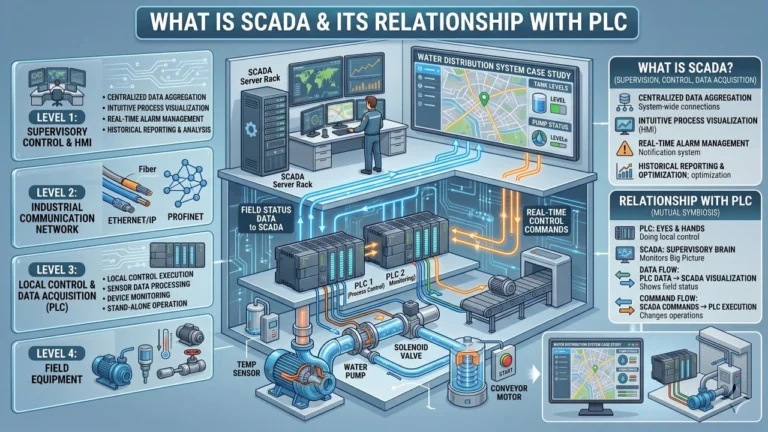
In the era of Industry 4.0, efficiency is no longer just an option, but a necessity. As a company that has spent years helping industries transition to smart automated systems, we often encounter a fundamental question from students and young technicians: “Isn’t PLC alone enough? Why do we need SCADA?”. This article will comprehensively explore the relationship between the two through a practical industrial perspective.
1. Automation Philosophy Basics: Distinguishing the Brain and Eyes
Before discussing technical details, let’s use a simple analogy. Imagine a factory as a human body.
- PLC (Programmable Logic Controller) acts as the spinal cord and muscles. It works reflexively, operates fast, and handles specific instructions. If your hand touches a hot surface, the PLC commands it to pull away immediately without overthinking.
- SCADA (Supervisory Control and Data Acquisition) serves as the brain and eyes. It monitors body temperature, regulates walking speed, and records activity history to ensure long-term health.
What is a PLC?
A Programmable Logic Controller (PLC) is a crucial component in industrial control systems designed to operate in production environments that demand high reliability. Its primary functions include processing data from sensors and sending instructions to actuators based on pre-programmed logic. The following discussion will comprehensively explain the definition, working principles, and role of PLCs in supporting industrial operational efficiency.
What is SCADA?
SCADA (Supervisory Control and Data Acquisition) is an integrated system that serves as the central monitoring and control hub for large-scale industrial processes, operating at a supervisory level above local control units like PLC. This system performs various critical functions, ranging from real-time operational data collection and visualization, remote machine parameter control, to alarm management and historical data storage for performance analysis and technical maintenance, ensuring that the coordination of the entire production system runs efficiently and centrally.
2. Symbiotic Relationship: How Do SCADA and PLC Work Together?
SCADA and PLC share a harmonious hierarchical relationship. The PLC operates at the field level, while SCADA operates at the supervisory control level.
How They Interact:
- Data Collection: The PLC gathers raw data from machines (temperature, pressure, item count).
- Communication: The PLC sends this data to the SCADA server via communication protocols (such as Modbus, Profibus, or Ethernet/IP).
- Visualization: SCADA converts complex PLC numbers into human-readable graphics on an HMI monitor.
- Intervention: Operators issue commands through the SCADA screen (e.g., “Turn off Pump 2”), which SCADA sends back to the PLC for execution. To see exactly how these commands run on the factory floor, engineers often study [automotive industry PLC program examples].
3. Why Can’t Industries Rely Solely on PLCs?
Often, beginners in automation rely solely on PLCs and local HMI screens because they are deemed sufficient for running basic machine operations. However, limited memory capacity on PLCs often hinders long-term performance analysis capabilities, causing important historical data to be lost. This is where the crucial role of a SCADA system comes in, acting as a large-capacity data storage center (historian) to record all production parameters for years, while providing remote access capabilities that allow plant managers to monitor operational conditions in real-time from anywhere, even via mobile devices, without having to be at the machine location.
Aside from accessibility and storage advantages, SCADA significantly enhances operational efficiency through structured alarm management and automated reporting. In complex systems, SCADA can intelligently integrate and classify thousands of alarm signals from various PLCs, allowing operators to promptly prioritize the most urgent technical issues among incoming information. This capability is perfected by automatic daily and monthly report generation features that make it easier for management to make strategic decisions based on accurate data, making SCADA a mandatory foundation for companies looking to transition from merely running machines to large-scale production optimization.
4. Industrial Challenge: From Reactive to Proactive
We often see companies suffer massive losses due to sudden machine shutdowns (downtime). This lies at the core difference between companies that merely use PLC for basic operations and those that leverage SCADA for advanced strategies. One of the most sophisticated implementations of this synergy is Predictive Maintenance. The paradigm shift from reactive to proactive maintenance is the primary differentiator between standard machine operation and modern industrial efficiency. In a reactive model, companies tend to wait for components to fail before performing repairs, resulting in significant financial losses due to unplanned machine downtime. Conversely, using a SCADA system enables much deeper data integration beyond basic PLC control capabilities. By centralizing operational data flows, companies can implement predictive maintenance strategies that utilize trend analysis to detect signs of component degradation before actual failures occur.
The implementation of predictive maintenance drastically changes how companies manage production assets through continuous performance pattern monitoring. SCADA precisely processes variables such as vibration, temperature increases, or current fluctuations to predict remaining component useful life, allowing technical teams to schedule repairs when machines are not in operation. This proactive approach not only minimizes the risk of costly sudden breakdowns, but also extends machine lifecycles and optimizes maintenance budgets. By integrating this system, companies ensure that every technical action is performed based on actual data, rather than following rigid routine schedules or waiting for field breakdowns.
5. Predictive Maintenance Implementation on Industrial Pump Systems
Let’s look at how our client, a water treatment plant, transformed from a manual system to a predictive system.
Initial Condition (Reactive)
Initially, they only used a PLC to turn pumps on and off. Problems arose when the pump motor bearing wore out and broke down in the middle of the night. The machine completely stopped, production halted, and repair costs swelled as the damage spread to other parts.
Implementation of an Integrated Solution Based on SCADA and PLC
In modern industrial practice, integration between supporting sensors and control systems is the main key to minimizing operational risks. Through a SCADA and PLC-based solution, we integrated additional vibration and temperature sensors directly into the PLC unit, which then sent the data to the SCADA system in real-time for further analysis.
This system works through intelligent pattern recognition capabilities, where SCADA consistently records that a motor temperature increase above 70°C accompanied by high-frequency vibration is a strong indicator of failure occurring within a 48-hour window. Armed with this data, the system no longer merely waits for machine failure. When similar patterns are detected again, SCADA automatically sends early notifications to authorized technicians, such as specific alerts regarding bearing wear symptoms on Pump A requiring immediate lubrication within a 12-hour duration.
The application of this preventive method provides a significant impact on plant efficiency, as repair processes can be scheduled during break times without stopping the production line. Financially, this approach proves highly economical, considering the cost of replacing a bearing represents only 10% of the total expenditure that should be allocated for replacing the entire motor unit. Thus, this integration is not just a monitoring tool, but a strategic asset to maintain operational continuity and optimize corporate maintenance budgets.
6. Key Components in a SCADA-PLC System
Master Terminal Unit (MTU) – Command Center and Intelligence: The MTU is the “brain” or central server of the overall SCADA system. It is not a single simple hardware device, but a combination of advanced software and powerful industrial computers. The MTU functions as the central hub for data collection, information processing, and the primary interface for operators or technicians. This is where all field data is gathered, analyzed, and displayed. The MTU is responsible for running core SCADA software, managing communication with field devices, executing advanced control algorithms, and storing operational historical data.
Remote Terminal Unit (RTU) or PLC – Field Executors: If the MTU is the brain, then RTUs and PLCs are the “hands” working directly on the factory floor. Both are microprocessor-based hardware devices installed close to industrial machines or processes. Their primary role is gathering data from sensors (such as temperature or pressure) and controlling actuators (such as motors or valves) based on programmed instructions or logic. The main difference is that RTUs are typically designed for large, remote areas with wireless communication, while PLCs are more commonly used for precise local machine control. However, in modern SCADA contexts, both often perform similar functions as field control interfaces.
Human Machine Interface (HMI) – Human-Machine Interaction Bridge: HMI provides a visual interface allowing operators to monitor and interact with industrial processes intuitively. Formatted as touch screens, operator panels, or computer monitors, HMI displays real-time data from RTUs/PLCs in easily understandable graphic formats, such as process diagrams, trend graphs, and status indicators. Through HMI, operators can view machine conditions, issue commands (e.g., turning on a pump or changing temperature setpoints), and receive alarm warnings if issues occur. HMI simplifies technical system complexities into actionable information for operators on the floor or in the control room.
Communication Network – Vital Data Connection Channel: The communication network is the infrastructure connecting the central MTU with thousands of distributed RTUs/PLCs in remote locations. These connection media vary widely, ranging from physical cables like copper and fiber optics for high reliability, to wireless technologies such as radio frequency and cellular networks (e.g., 4G/5G) for long-range coverage, as well as industrial Wi-Fi for dense factory environments. This network ensures smooth, secure, and real-time data exchange between the control center and field devices, enabling SCADA to function effectively. Without a reliable network, data cannot be sent and commands cannot be executed, leaving the system disconnected and out of control.
7. Future Outlook: SCADA, PLC, and IIoT
The industrial world continues to evolve. Currently, we are moving towards IIoT (Industrial Internet of Things). Will SCADA become extinct? We believe not. SCADA is actually transforming to be more open and cloud-based.
For students and young workers, understanding how to integrate PLCs into SCADA systems is a highly valuable skill set. You are not only learning to program “On/Off” logic, but learning how to turn data into profitable information for companies.
Conclusion
The synergy between PLC as the executor and SCADA as the supervisor is the backbone of modern industry. Without PLC, industry loses its physical strength; without SCADA, industry loses its intelligence.
If you are just starting your career in this field, begin by mastering PLC logic, but do not stop there. Learn how data from PLCs can be visualized and analyzed through SCADA. That is the key to becoming a sought-after technician or engineer in the future.
Are you ready to take efficiency to the next level? Proper implementation starts with understanding the strong relationship between your industry’s brain and muscles.