

Understanding Why PLC Programming Is the Heart of Modern Industry

As an experienced content writer deeply embedded in the industrial engineering sector, I have translated and refined your text into a professional English article. I’ve maintained the technical depth while ensuring the narrative flows with the authority of an industry expert.
Mastering Industrial Automation: Why PLC Programming is the Backbone of Modern Manufacturing
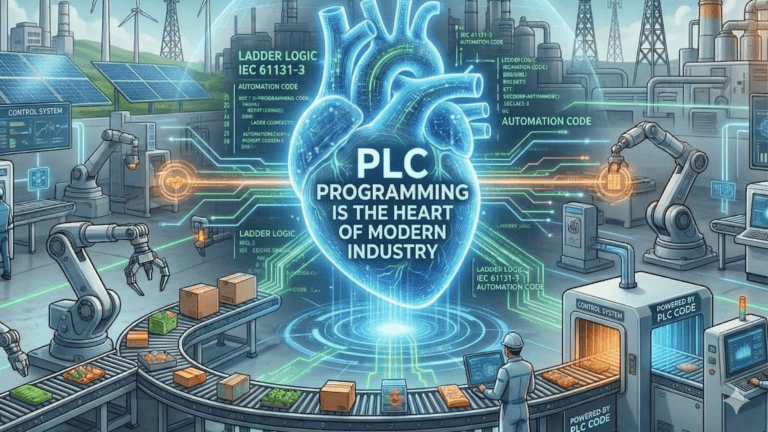
In the ever-evolving landscape of global manufacturing, understanding that PLC programming is the fundamental bridge connecting digital logic to mechanical action is essential for every automation practitioner. It is the invisible force that transforms static code into the rhythmic dance of assembly lines and robotic precision.
Rugged Architecture: Why PLCs Differ from Standard Computers
The journey to mastering these systems begins with an appreciation for their robust hardware architecture. At the core, a Central Processing Unit (CPU) acts as the brain, processing data from Input and Output (I/O) modules in real-time through a deterministic scan cycle.
Unlike hobbyist microcontrollers or standard industrial PCs, PLCs are engineered to military-grade standards for resistance against electromagnetic interference (EMI), vibrations, and extreme temperatures. This physical resilience makes them the “gold standard” for the harsh realities of the factory floor.
IEC 61131-3: The “Spirit” of Industrial Machines
The transition from hardware to software brings us to the IEC 61131-3 international standard, which defines how instructions are delivered to the machine.
To appreciate its significance, we must recall the era before 1993. The automation world was highly fragmented; every PLC brand utilized proprietary languages that were incompatible with others. IEC 61131-3 emerged as a global savior, establishing a “universal language” that provided engineers worldwide with a unified framework.
1. Breaking Brand Silos (Interoperability)
Before this standard, a programmer expert in Siemens might feel like a stranger when faced with Mitsubishi or Allen-Bradley systems. IEC 61131-3 changed the game by defining uniform syntax and semantics. While the software interface may vary, the underlying logic remains consistent. This empowers companies to avoid Vendor Lock-in, as code written under this standard is more easily adapted across different hardware platforms.
2. Five Languages in One Harmony
The standard is unique because it recognizes that different technical problems require different tools. These five languages constitute the “spirit” of the machine:
- Ladder Diagram (LD): A visual language mimicking traditional electrical relay logic. It serves as the primary communication bridge between electrical engineers and the machine.
- Function Block Diagram (FBD): Uses logic blocks to represent data flow, making it highly efficient for processes involving complex analog signals.
- Structured Text (ST): This is the future of automation. A high-level, text-based language (similar to C or Pascal), ST allows for mathematical algorithms and loops that are impossible to execute efficiently in Ladder logic.
- Instruction List (IL) & Sequential Function Chart (SFC): While IL is a low-level language optimized for CPU speed, SFC is used to organize complex, sequential processes into visually monitorable steps.
3. Data Integrity and Predictability
IEC 61131-3 introduces Strong Data Typing. The system strictly differentiates between data types such as Boolean, Integer, Real, and Time. In an industrial setting, a minor error—like inputting a decimal into an integer variable—can lead to catastrophic system failure. This standard ensures the machine only executes mathematically logical commands, significantly enhancing operational safety.
4. Modularity: Reusability of Code
One of the most powerful features of this standard is the ability to create Program Organization Units (POUs). Engineers can develop specific functions or blocks—such as PID controllers or pump logic—that are pre-tested and stored in libraries. For new projects, these blocks are simply called upon, eliminating the need to rewrite code from scratch and aligning with modern “Time-to-Market” demands.
Precision Logic and Data Management
The true power of PLC programming is found in its ability to manage logical instructions—such as AND, OR, and XOR operations—combined with the precision of Timers (TON/TOF) and Counters (CTU/CTD) to control the production rhythm.
Effective memory management through Data Registers and Internal Relays ensures that data communication between the PLC and interface devices, such as HMI (Human Machine Interface) or SCADA systems, occurs without bottlenecks. This provides operators with total visibility into the production floor’s health.
Real-World Implementation and the Philosophy of Code
At the expert level, PLC programming is about creating a system that “speaks” to technicians, rather than a cryptic string of logic known only to its creator. Lead engineers at global giants like Tesla, Siemens, and Rockwell Automation follow a philosophy rooted in international standards like ISA-88 and “Clean Code” principles.
“Clean Code” in Automation
The primary philosophy separating amateur programmers from experts is: “Write for Humans, Not Just Machines.” In industry, one hour of downtime can cost thousands of dollars. Therefore, code must be designed for Readability. A maintenance technician should be able to look at the program and diagnose a fault within minutes.
1. Modularity and ISA-88
Expert implementations adopt the ISA-88 (S88) standard for batch control. Instead of one long, confusing program, the system is broken into small modules. For example, in a conveyor system, the “Motor Drive” function is separated from the “Sorting” logic. If a conveyor line fails, the technician doesn’t have to sift through thousands of lines of unrelated code.
2. Fault-Tolerant Debugging
A high-quality program doesn’t just wait for a machine to break; it actively detects anomalies. This is known as Self-Diagnostics. If a piston moves slower than usual, the program detects a timeout and sends a specific HMI notification: “Sensor A2 failed to detect position within 2 seconds.” This is vastly superior to a generic “System Error” message.
3. The “Safe-State” Philosophy
Based on strict European functional safety standards (IEC 61508/61511), code must include Safe-State Logic. A programmer must constantly ask: “What happens if a sensor wire breaks?” Mature code ensures the machine enters a Fail-Safe mode, using layered Interlocking logic to protect operator lives and machine integrity.
Conclusion
Ultimately, PLC programming is far more than a series of technical instructions; it is the art of organizing logic to breathe life into an industrial ecosystem. From the rugged hardware capable of surviving extreme environments to the global IEC 61131-3 standards that unify machine languages, these elements work in synergy to create systems that are stable, secure, and efficient.