

PLC Timer and Counter Functions: Why Your Logic Stalls the Factory Floor

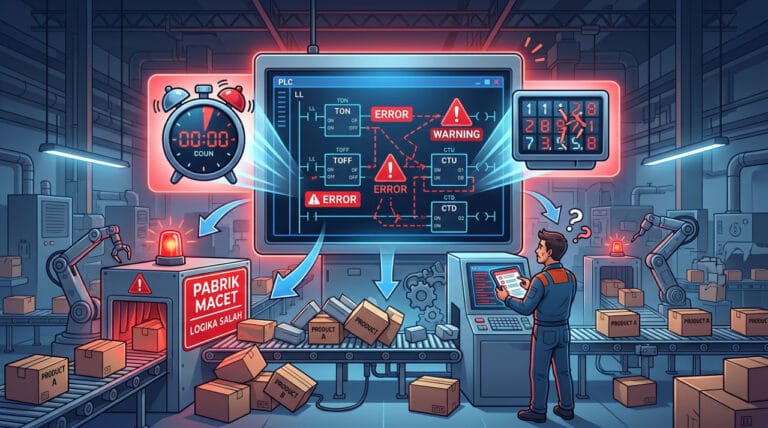
Your factory floor stops unexpectedly. It is not because a machine broke down; it is because your PLC code is messy.
Many programmers treat Timers and Counters as trivial, minor tools. That is a critical mistake. A single millisecond error on an Off-Delay Timer can crush a pneumatic cylinder or ruin products on a conveyor belt instantly. We frequently find systems that stall completely just because a programmer fails to understand how these instructions interact with the processor’s scan cycle speed.
Timers: Regulating the Rhythm of Production, Not Just Alarm Clocks
Never think of a Timer as just a tool to delay execution time. Think of a Timer like a heartbeat. If the beat fails, the entire body—the machine—dies.
We often see amateur programmers use Timers as a “band-aid” to cover up slow sensors or low-quality hardware. That is not a solution. That is lazy engineering that multiplies your problems down the road.
You must realize that overusing Timers hungrily consumes your PLC’s working memory. Logic filled with unorganized Timers becomes a ticking time bomb the moment you demand faster production rates. We challenge you to strip away unnecessary time delays and start designing solid sensor interlocks.
Our focus at Folks Automation is to help you design efficient Timer and Counter functions in PLC programming to maximize your factory output without sacrificing system stability.
Why ‘Band-Aid’ Timers Ruin Your Efficiency
If you use a Timer simply to wait for an unstable sensor to give a signal, you create jitter and uncertainty within your system. Misplaced Timers ruin synchronization between machines, especially on high-speed conveyor lines that require pinpoint precision. We see many industrial systems fail to scale because the programmer prefers adding seconds rather than fixing the underlying object detection logic.
High-quality Timer and Counter functions in PLC programming must regulate the rhythm of the machine, ensuring every mechanical movement occurs at the exact right moment.
Our team at Folks Automation ensures you no longer get stuck in a “delay logic” that heavily burdens the processor’s scan cycle. By streamlining your Timer instructions, we help you achieve shorter cycle times, which directly maximizes your factory’s production output. Stop relying on tedious time delays and start building an organic, responsive automation system.
Read Also: The Core Foundation of Modern PLC Programming
Counters: Precision Asset Tracking, Not Just Adding Numbers
Think of a PLC Counter as a security guard standing at a stadium turnstile. Their job is simple: count every person who walks in. However, a fatal issue arises when the turnstile shakes violently or when someone moves back and forth in front of the sensor. Many beginner PLC programmers fall into the trap of simply adding a Counter block without considering signal bouncing or electrical noise. Without precise debouncing logic, your virtual guard will count ghosts, leading to inaccurate warehouse inventory.
Another amateur programming mistake is failing to synchronize sensor speed with the PLC scan cycle. If products move on a high-speed conveyor belt while your PLC program loop is too long or heavy, your guard will “blink” and miss the passing items. We frequently encounter cases where standard counters are wrongly used for high-frequency applications, even though the system requires a High-Speed Counter (HSC) or interrupt-based instructions. You cannot force an old guard to count sprinters; your machine needs a logic framework that keeps pace with real-world speeds.
The data generated by your PLC Counter is the heartbeat of your production reports. If you trigger the Reset instruction carelessly or forget to configure Retentive Memory, your total count will vanish instantly during a power outage.
At Folksautomation, we do more than just draw lines on a Ladder Diagram. We help you design robust PLC Timer and Counter functions that withstand electrical noise and data synchronization issues. We ensure your gatekeeper operates with millisecond precision to maximize factory output, eliminating end-of-shift inventory discrepancies once and for all.
How to Prevent PLC Timer and Counter Logic Failures in Industrial Automation
Stop relying on lazy delays and unverified counts. At Folks Automation, we build clean, robust, and lightning-fast PLC programming structures designed for heavy industrial environments.
Contact our engineering team today to audit your automation logic and boost your factory’s true throughput.
Preventing Race Conditions: When Timers and Counters Collide
You must understand that a dangerous scenario called a Race Condition often occurs within PLC Timer and Counter functions. This happens when a Counter’s Reset instruction triggers faster than a Timer finishes its count, or vice versa. Imagine two relay runners trying to pass a baton, but one sprints off before actually catching it.
If you fail to establish a strict priority sequence, the machine gets confused between advancing to the next stage or resetting to the beginning. The result? Your machinery frequently gets stuck mid-process without throwing any clear error codes. We constantly find code packed with stacked instructions that lack solid interlocking. This sloppy programming method increases the PLC scan cycle load and severely slows down machine response times.
We help you build high-precision PLC programming. Do not let your factory lose profits due to inaccurate timer logic. Contact us at +6282114044968 today to optimize your industrial automation systems.